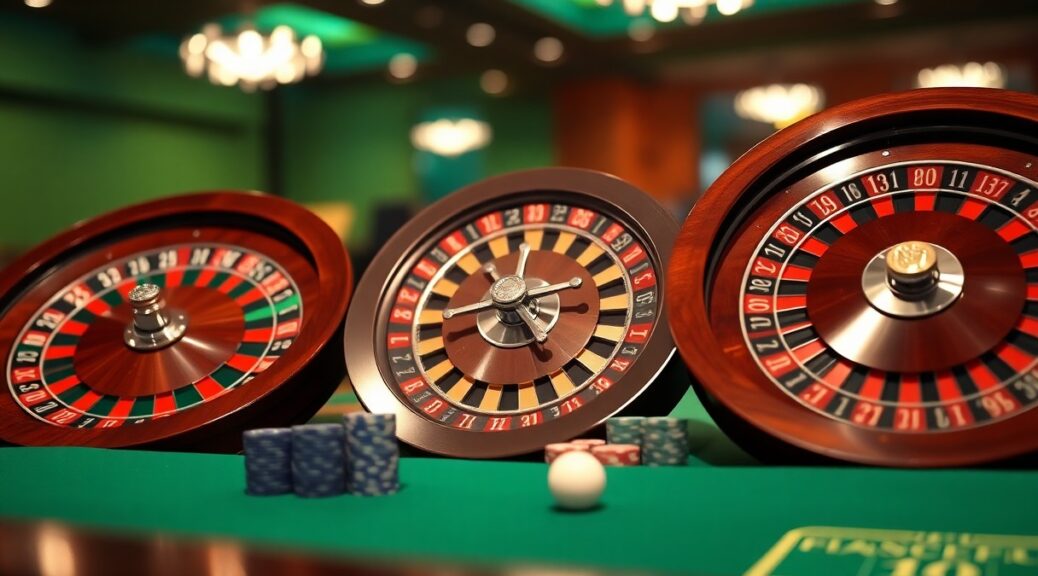
Understanding The Different Types Of Roulette Wheels: American Vs European Vs French
You will learn the structural and rule differences among roulette wheels to make smarter choices. The American wheel’s extra 00 (38 pockets) raises the house edge, making it the most dangerous for players; by contrast the European and French wheels use a single zero (37 pockets) and offer a lower house edge. The French game often applies the La Partage rule, which can return half your even-money bet. Use these distinctions to manage risk and returns.
Types of Roulette Wheels
| Wheel | Key features |
|---|---|
| American Roulette | 38 pockets (1-36, 0, 00); house edge 5.26% |
| European Roulette | 37 pockets (1-36, 0); house edge 2.70% |
| French Roulette | 37 pockets; La Partage/En Prison lowers edge to ~1.35% on even bets |
| Other/Variants | Mini, multi-wheel and specialty layouts with varied rules |
Different tables change odds, layout and betting options; common types are shown below:
- American Roulette
- European Roulette
- French Roulette
Recognizing these differences helps select the right game for risk tolerance and strategy.
American Roulette
American wheels have 38 pockets (numbers 1-36 plus 0 and 00), which produces a house edge of 5.26%; that higher edge increases long‑term loss potential and variance, so players seeking lower casino advantage usually avoid American tables despite identical payout structures.
European Roulette
European wheels use 37 pockets (single 0), yielding a lower house edge of 2.70% and an effective RTP of about 97.3%; common in land casinos across Europe, this layout favors even‑money strategies and is the standard for most player‑friendly roulette tables.
In practice European tables often support the racetrack (announced) bets-Voisins du Zéro (covers 17 numbers), Tiers (12 numbers) and Orphelins (8 numbers)-allowing strategic sector plays; many casinos list these on the table diagram, enabling experienced players to target wheel sectors and neighbors.
French Roulette
French roulette shares the single‑zero wheel but typically adds rules like La Partage or En Prison, which halve or suspend losses on even‑money bets and reduce the effective house edge to about 1.35%, making it the most favorable standard variant for cautious players.
Specifically, La Partage immediately returns half of an even‑money stake when the ball lands on zero, while En Prison leaves the stake “in prison” for the next spin-if that spin wins the original bet is returned-both mechanisms significantly improve player odds on outside bets and are common at French tables and premium casino sections.
Key Differences Between Wheel Types
Comparing American, European and French wheels highlights pockets, sequencing and rule sets: the American wheel has both 0 and 00 (38 pockets) producing a 5.26% house edge, while European and French wheels use a single 0 (37 pockets) with a 2.70% edge and optional rules that cut edge on even bets. Examples: la partage halves loss on even bets; en prison can effectively reduce edge further.
- American – 38 pockets, 0 & 00
- European – 37 pockets, single 0
- French – single 0 plus la partage/en prison rules
| Zeros | American: 0 & 00; European/French: single 0 |
| Number of pockets | American 38 vs European/French 37 |
| House edge (single-number) | American 5.26% · European 2.70% · French 2.70% (even bets can be 1.35%) |
| Layout/sequence | Different number ordering and pocket spacing affect ball behavior and visual familiarity |
| Special rules/appeal | French rules (la partage/en prison) favor risk-averse players; American is higher variance |
Design and Layout
Wheel construction alters play: the American rotor and wheel head accommodate two zeros and slightly different pocket spacing, while the European and French wheels use a single-zero rotor and a distinct number sequence that can influence clustering. Casinos may use different materials and pocket separators that change ball bounce; professional dealers and bias studies often reference wheel sequence and pocket tolerances when analyzing outcomes.
House Edge
Numerical differences matter: a straight-up bet on an American wheel yields a house edge of 5.26% because of the extra 00, whereas both European and French single-zero wheels sit at about 2.70%. Specific rule sets like la partage halve the loss on even-money bets, cutting the effective edge to roughly 1.35% for those wagers.
The math shows why: on an American wheel a single-number bet (pays 35:1) has EV = (1/38)*35 + (37/38)*(-1) = -2/38 (≈ -5.26%); on a European wheel EV = (1/37)*35 + (36/37)*(-1) = -1/37 (≈ -2.70%). Applying la partage to an even-money bet halves the losing-side expectation, producing an effective house edge around 1.35% on those bets. The
Tips for Choosing the Right Roulette Wheel
Focus on wheels with a single-zero layout, solid maintenance and consistent payouts-a straight-up still pays 35:1. Check the published house edge: American 5.26%, European 2.70%, French ~1.35% with la partage. Inspect dealer speed, wheel wear and bias reports; compare minimums and maximums to your session plans. Any serious player balances those factors against bankroll, session length and preferred volatility.
- American: double-zero wheel, 5.26% house edge
- European: single-zero wheel, 2.70% house edge
- French: single-zero + la partage/en prison, effective ~1.35%
- Table limits: minimums and maximums that shape strategy viability
- Wheel condition: wear and bias reports affect long-term expectations
Understanding Your Betting Style
If you prefer low volatility, concentrate on even-money bets: on a European wheel red/black wins 18/37 times (~48.65%) and keeps swings small. By contrast, inside bets (straight-up 35:1) have ~1/37 chance on single-zero-good for high-payout hunters but higher variance. Combining stake-sizing rules (flat, proportional, or progressive) with your time horizon and bankroll targets determines which wheel type and limits fit your approach.
Considering Table Limits
Table limits dictate which strategies survive: many casinos set minimums at $1-$5 and maximums from $500 to $5,000. A strict max can kill doubling systems; for example, a $5 min bet doubling six times requires a $320 max (5·2^6). Match your stake plan to the table limits and expected session length before choosing a wheel.
More detail: with a $500 bankroll and $1 minimum, a six-step Martingale needs a $63 stake ceiling (sum of 1+2+4+8+16+32), so any table max below $63 prevents recovering after six losses. Conversely, low minimums allow wider progression with modest bankrolls, while high maximums enable aggressive cover strategies but increase potential losses-adjust bet size, not just wheel preference, to manage risk.
Step-by-Step Guide to Playing Roulette
| Step | Action / Tip |
|---|---|
| 1. Place Bets | Put chips on numbers, splits, streets, corners or outside areas before the dealer closes betting. |
| 2. Dealer Spins | Dealer launches the ball; when they announce “no more bets” chips lock – timing matters. |
| 3. Outcome | Ball lands in a pocket; dealer calls number, color and pays winning bets. |
| 4. Payouts | Collect according to payout table (e.g., straight-up 35:1, even-money 1:1). |
| 5. Reset | Clear losing chips, collect winnings, then begin next round. |
Placing Your Bets
Place chips on specific pockets for inside bets (straight-up pays 35:1, splits 17:1, corners 8:1) or on outside bets like red/black and dozens (1:1 and 2:1). Use chips of one color to avoid mix-ups, and act before the dealer says “no more bets.” Keep in mind the wheel type affects house edge: American 5.26% vs European 2.70%.
Understanding Payouts
Know the standard payouts: straight-up 35:1, split 17:1, street 11:1, corner 8:1, line 5:1, column/dozen 2:1, even-money 1:1. Payouts look generous but differ from true odds; that gap creates the house edge, which varies by wheel and rule set (for example, French la partage can cut even-money house edge to 1.35%).
For concrete perspective: on a European wheel (37 pockets) a straight-up win probability is 1/37 (~2.70%). Betting $10 straight-up yields an expected loss of about $0.27 per spin (house edge ~2.70%). On an American wheel (38 pockets) those numbers shift and the expected loss rises to about 5.26% of wagers, explaining why wheel choice matters for long-term results.
Factors Influencing Your Game
Several elements shift outcomes: table layout, wheel maintenance, dealer speed, bet selection and session variance. Choosing a European or French single-zero wheel lowers the house edge compared with the American double-zero (2.7% vs 5.26%), while worn wheels can produce repeat hits. Small rule differences like en prison cut expected loss further. Recognizing how wheel type, maintenance and stake sizing interact lets you adjust risk and tactics.
- Wheel condition – wear induces bias
- Table rules – en prison/la partage vs standard
- Bet choice – outside vs inside impacts variance
- Dealer and tempo – affects rhythm and tracking
Wheel Bias
Physical imperfections or installation errors can create a wheel bias, where certain pockets hit more than the 1/37 (European) or 1/38 (American) expectation; Joseph Jagger’s 1873 investigation is a classical example. Advantage players log thousands of spins to detect deviations of even 0.5-2 percentage points above expectation, then report or exploit them; modern casinos counter by rotating wheels, rebalancing rotors and performing precise maintenance.
Player Strategy
Bet selection and bankroll control shape any effective player strategy. Favoring outside bets reduces volatility while straight-up wins pay 35:1 but occur infrequently; systems like the Martingale do not change the house edge and can produce catastrophic losses against table limits. Use fixed unit sizes and loss thresholds to manage drawdowns.
Quantify your approach: on a European wheel expected loss is ~2.7% of turnover, so a €1,000 turnover implies ~€27 long-term loss; setting unit bets at 0.5-2% of bankroll limits ruin risk. Combine even-money coverage for steady returns with selective inside-play for upside, exploit en prison/la partage rules when present to halve expected loss (~1.35%), and run 10,000-spin simulations to validate any staking plan before scaling up.
Pros and Cons of Each Roulette Wheel
| Pros | Cons |
|---|---|
| Lower house edge on single-zero wheels: European 2.70%; French can drop to 1.35% on even bets with La Partage. | Higher house edge on American: 5.26% due to the extra 00 pocket. |
| Player-friendly rules (La Partage/En Prison) reduce long-term losses on even-money bets. | American lacks La Partage/En Prison, increasing expected loss and variance for even bets. |
| Single-zero math simplifies bankroll planning and strategy testing (accurate RTP modeling). | Double-zero increases volatility, making streaks and drawdowns more pronounced. |
| Better for conservative systems and long sessions; lower RTP swing benefits small-stake play. | Less attractive for high-risk players seeking big short-term payouts or novelty side bets. |
| Widely offered online under “European/French” labels with consistent odds. | In some regions (notably the US) single-zero wheels are less available, limiting choice. |
| French tables often have cultural features and rules that favor even bets for patient players. | French rule benefits apply only to even-money bets, so straight-up and combination bets see no advantage. |
| Fewer side bets and gimmicks mean clearer expected-value comparisons. | American tables offer more betting variants and spectacle, which some players prefer despite worse odds. |
| Single-zero wheels are generally preferred by advantage players and long-term bankroll managers. | Casinos may remove La Partage or alter rules locally, so advertised advantages aren’t always present. |
Advantages of American Roulette
American roulette’s main appeal is its pace and variety: the 00 pocket enables unique bets (like the five-number bet) and higher volatility, attracting risk-seeking players and side-bet enthusiasts. Casinos in the US typically offer more American tables, making it easy to find action; dealers often run faster, increasing spins per hour and short-term win potential. For players chasing excitement and larger variance, American wheels deliver more dramatic sessions despite a 5.26% house edge.
Disadvantages of European and French Roulette
European and French wheels reduce house edge but trade off volatility and availability: the single-zero layout yields a 2.70% edge (and 1.35% on even bets with La Partage), which limits big short-term swings that gamblers seeking quick, large wins prefer. Additionally, many US casinos rarely offer single-zero tables, so players in North America may struggle to find them live.
More detail: La Partage and En Prison only affect even-money bets, so players who favor straight-up or combination wagers don’t get the same reduction in expected loss. Also, some casinos advertise “European” rules online but omit La Partage in practice, and minimums at premium French tables can be higher-both factors that reduce the practical benefit of the lower theoretical house edge.
Summing up
Upon reflecting on American, European and French roulette, the wheels differ primarily by pocket configuration and rules: American has 0 and 00 (higher house edge), European a single 0 (lower edge), and French offers the same single zero plus favorable rules like La Partage and En Prison that further reduce house advantage; table layouts and wheel balance affect play and strategy choice, so players should prefer single-zero variants when seeking better odds and informed decision-making.
FAQ
Q: What are the mechanical and layout differences between American, European, and French roulette wheels?
A: American roulette uses 38 pockets (numbers 1-36 plus 0 and 00); European and French wheels use 37 pockets (numbers 1-36 plus a single 0). The order of numbers around the wheel differs between American and single-zero wheels, affecting wheel balance and number adjacency but not basic payout structure. French tables often include additional markings and a different table layout for call bets (announced bets) and may pair the wheel with a wooden layout or wheel style that reflects European casino tradition. The key visible distinctions are the presence of the double zero on American wheels and the table markings and terminology used at French tables.
Q: How do house edge and special rules (La Partage, En Prison) change player odds across the three variants?
A: With a double zero, American roulette has a house edge of 5.26% on most bets because payouts remain the same while the extra pocket increases casino advantage. European roulette’s single zero reduces the house edge to 2.70% across standard bets. French roulette often offers La Partage or En Prison on even-money bets: La Partage returns half your bet if the ball lands on zero (reducing the effective house edge on those bets to about 1.35%), while En Prison allows the bet to be held for the next spin with similar long-term effect if the next spin wins. Outside of these special rules, payouts and basic probabilities are identical to European single-zero roulette.
Q: How should a player choose between the wheel types and adjust play or strategy accordingly?
A: Prefer single-zero (European or French) wheels when available because they offer a significantly lower house edge than American double-zero. If you find French tables with La Partage or En Prison, favor even-money wagers there to exploit the reduced effective edge. Betting systems do not overcome the house advantage; manage bankroll and bet sizing to control variance rather than chasing a guaranteed win. If only American roulette is available, accept higher variance and house edge by limiting bet size and avoiding strategies that rely on favorable long-term expected value differences that do not exist.