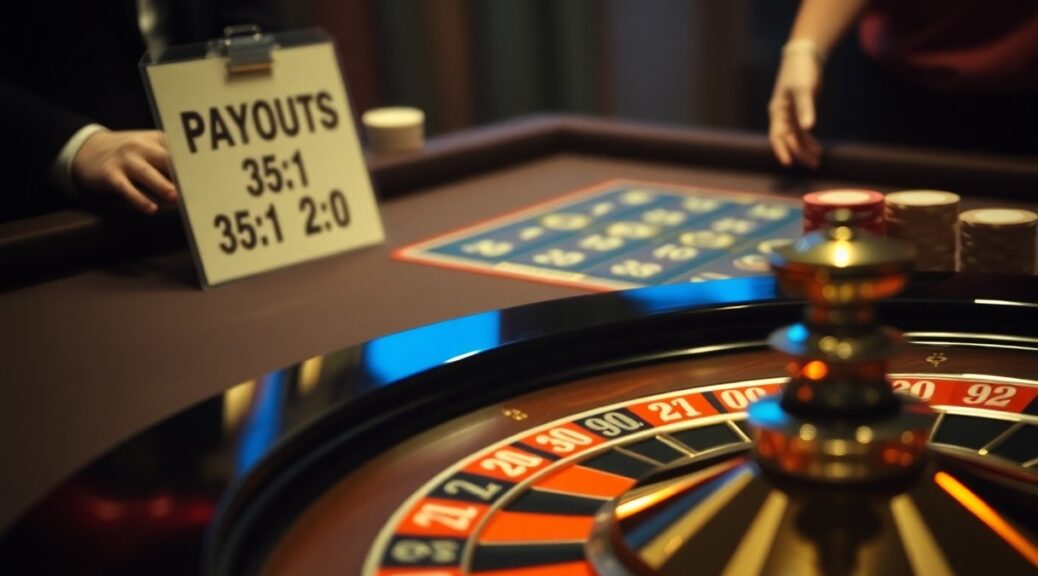
An Easy-to-Follow Breakdown Of Roulette Rules And Payouts
Roulette explains the game’s mechanics, common bets and payouts in plain terms so beginners can learn quickly and avoid common pitfalls. Learn the wheel layout and how inside bets yield higher payouts but carry greater risk, why outside bets are safer with steadier returns, and how the house edge affects long-term results to make informed wagering decisions.
Understanding Roulette Types
- European Roulette
- American Roulette
- French Roulette
- Single Zero
- Double Zero
| Pockets | European/French: 37; American: 38 |
| Zero types | Single zero (0) vs Double zero (00) |
| House edge (even bets) | European: 2.70%; French with La Partage/en prison: 1.35%; American: 5.26% |
| Special rules | La Partage, en prison (French); none that reduce edge (American) |
| Common venues | European/French: Europe and many online tables; American: US casinos and many commercial floors |
European Roulette
European Roulette runs on a single zero wheel with 37 pockets, producing a standard house edge of about 2.70%. Many players prefer it because even-money bets and outside strategies have measurably better odds than American. Tables commonly offer straight, split, street, corner and column bets; wheel symmetry and standard numbering make probability calculations straightforward for bankroll planning.
American Roulette
American Roulette includes both 0 and 00 on a 38-pocket wheel, which raises the house edge to roughly 5.26% on even-money wagers. That extra pocket materially increases long-term loss rates, so aggressive systems that ignore the double zero face larger expected declines. Casinos in the U.S. favor this layout for higher margin per spin.
With a $100 even-money bet the expected loss is about $5.26 on American wheels; the added 00 doubles the gap versus single-zero in many scenarios. Wheel layout and bet differentials make volatility higher, so players adjusting strategy should reduce stake sizes or seek single-zero alternatives when possible.
French Roulette
French Roulette uses a single zero wheel but adds rules like La Partage or en prison that cut the house edge on even-money bets to about 1.35%. Those rules halve losses when zero appears or allow the bet to ride, making French tables the most favorable for conservative, low-variance play among standard variants.
Assume that on an even-money wager La Partage refunds half your stake if zero lands, reducing expected loss from 2.70% to 1.35%; en prison holds the bet for a second spin with similar effect, and French tables also feature call bets (voisins, tiers, orphelins) and distinctive wheel markings that affect sector-based betting.
Step-by-Step Guide to Playing Roulette
| Step | Action |
|---|---|
| 1. Buy chips | Exchange cash for table chips and note the table’s minimum and maximum limits. |
| 2. Place bets | Select inside or outside bets; dealer spins once all wagers are set. |
| 3. Spin | Dealer launches the ball; no more bets announced before settling. |
| 4. Payouts | Dealer pays winning chips according to bet type (e.g., straight 35:1, even-money 1:1). |
| 5. Collect | Take winnings or leave chips on table for next spin; watch for rake or table nods. |
Placing Your Bets
Place chips on the layout before the dealer calls “no more bets.” Inside bets like a single-number straight pay 35:1 and offer high payouts but greater variance, while outside bets such as red/black or odd/even pay 1:1 and reduce volatility. Tables commonly have minimums of $1-$5; always check the posted limits and size wagers to your bankroll.
Understanding the Betting Board
The board shows numbers 0-36 arranged in three columns; European wheels have one 0 and a ~2.70% house edge, whereas American wheels add a 00 raising the edge to ~5.26%. Outside bets (dozens, columns) are on the right, inside bets occupy the numbered grid, and placement location determines the bet type and payout.
Inside bet examples: straight pays 35:1, split 17:1, street 11:1, corner 8:1, line 5:1. Outside bets: dozens/columns pay 2:1, even-money pay 1:1. Place a chip directly on a number for a straight, on the line between numbers for a split, at the intersection for a corner, and on the outer boxes for dozens or columns; American layouts include the additional 00 pocket affecting odds.
Strategizing Your Plays
Use flat-betting to preserve your bankroll and keep bet sizes predictable; even-money bets extend session length while dozens/columns (2:1) balance risk and reward. Avoid overreliance on progressives-the house edge never changes and table limits can stop recovery sequences quickly, so plan stakes relative to available funds.
Concrete example: a $5 Martingale sequence goes 5, 10, 20, 40, 80, 160-after six losses the next required bet is $320 and total staked so far is $315, which can hit typical table maximums of $500-$1,000. Set a stop-loss, define a clear win goal (e.g., 20% of bankroll), and size initial bets to about 1-2% of your bankroll to manage variance effectively.
Roulette Tips for Beginners
Prioritize playing on single-zero wheels, favor even-money bets while learning, and keep unit sizes small relative to your bankroll; the European wheel carries a 2.7% house edge versus 5.26% on American double-zero. Watch table minimums and dealer speed to avoid rushed decisions. Perceiving table selection and stake discipline separates casual players from consistent winners.
- Bankroll Management
- Table Selection
- Bet Types
- House Edge
Bankroll Management
Set session limits and size units at about 1-2% of your total bankroll per spin; with a $500 bankroll, use $5-$10 units. Implement a stop-loss (e.g., lose 20% of session bankroll) and a profit target (e.g., win 25%) to lock gains. Log spins and outcomes, avoid increasing stakes after losses, and treat each spin as an independent event to protect longevity.
Choosing the Right Table
Opt for tables with single-zero wheels, lower minimum bets that match your unit size, and clear posted limits; a $5 minimum on a European wheel is preferable to a $25 minimum on an American wheel for small bankrolls. Check for rules like en prison or la partage that reduce even-bet house edge to 1.35%.
Observe 20-30 spins before joining to assess dealer speed, wheel condition, and any irregularities; those details affect bet timing and comfort. Consider expected loss: at $5 per spin over 1,000 spins, expected loss ≈ $135 on European versus ≈ $263 on American-choose the table that aligns with your bankroll and tolerance for variance.
Avoiding Common Mistakes
Steer clear of chasing losses and aggressive progression systems like the Martingale, which can require >100× your base unit after a losing streak-7 consecutive losses needs a 128× bet. Avoid betting beyond preset units, playing under influence, or relying on “hot” streak myths; these behaviors inflate variance and drain funds quickly.
Institute strict session rules-e.g., stop after losing 20% or winning 30%-and take breaks to reassess. Note that long streaks do occur (7+ same-color runs in 1,000 spins occur roughly 5% of the time), so plan for variance rather than trying to outguess it to preserve capital and learning progress.
Key Factors Influencing Roulette Outcomes
- Randomness
- Probability
- House Edge
- Betting Systems
- Table Limits
Randomness and Probability
Roulette outcomes are driven by mechanical and electronic randomness, so each spin is independent: a straight-up on European roulette is 1/37 (about 2.70%), while red/black pays even money with a win probability of 18/37 (~48.65%). Statistical tools like expected value and variance explain short-term swings versus long-term convergence toward theoretical probabilities.
House Edge
The game’s built-in advantage comes from the zero pockets: European single-zero gives a 2.70% house edge, American double-zero raises that to 5.26%, and those percentages determine the negative expected return per bet regardless of win streaks or patterns.
The house edge translates into predictable long-term loss: a 1-unit bet in European roulette has an expected loss of ~0.027 units per spin, while American roulette loses ~0.0526 units per spin. Over 1,000 spins that’s roughly 27 units versus 52.6 units expected loss, and variance may mask this for hundreds of spins but cannot remove the structural disadvantage.
Betting Systems
Popular staking plans like Martingale, Fibonacci and D’Alembert alter bet size, not expected value; the house edge stays the same while exposure to large, rare losses increases, especially against table limits and finite bankrolls.
For example, Martingale theoretically recovers after a loss streak by doubling bets: after 10 consecutive losses you’d need 2¹⁰ = 1,024 units to continue, and the probability of 10 straight losses on an even-money European bet is about 0.13%; that tiny chance carries severe ruin risk and is amplified by real-world table limits.
Any strategy that ignores the house edge, table limits or bankroll volatility risks rapid, significant losses.
Pros and Cons of Playing Roulette
| Pros | Cons |
|---|---|
| Simple rules and fast rounds, ideal for beginners. | House edge present on every bet; American: 5.26%, European: 2.70%. |
| Wide bet variety from straight (high payout) to even-money options. | High variance: a few spins can erase a session bankroll quickly. |
| Straight-up pays 35:1, even-money pays 1:1. | No long-term skill advantage; outcomes are independent and random. |
| Low minimum bets online (often <$0.50) make play affordable. | Popular betting systems (Martingale) require large bankrolls and fail long-term. |
| Social, fast-paced casino atmosphere suits casual players. | Emotional chasing of losses increases risk of large bets. |
| Available in multiple formats: live, electronic, and mobile. | American double-zero format increases casino profit substantially. |
| Good for short sessions and entertainment value. | Expected loss scales with total wagered; longer play increases the house advantage. |
Advantages of Roulette
Beginners benefit from straightforward mechanics and a broad bet menu: a straight-up pays 35:1, while even-money bets return 1:1, letting players choose low-volatility or high-reward lines. Many online tables accept bets under $0.50, and European wheels offer a lower house edge of 2.70%, making roulette both accessible and flexible for casual play or strategy experimentation.
Disadvantages of Roulette
The main drawbacks are variance and built-in casino advantage: the American wheel’s 5.26% house edge and the fact that outcomes are purely random mean no betting system can overcome losses long-term. Sessions can swing wildly, and chasing losses often multiplies risk rapidly.
Quantitatively, expected loss equals total wagered multiplied by the house edge: betting $1,000 across spins on a European wheel implies an average loss near $27, while on an American wheel it’s about $52.60. Additionally, strategies like Martingale require exponentially growing stakes-for example, covering 10 consecutive $1 losses would need a follow-up stake of $1,024-so bankroll and table limits typically prevent long-term recovery and amplify downside risk.
Roulette Payouts Explained
Straight bets return 35:1 on a single number; splits pay 17:1, streets 11:1, corners 8:1, and dozens/columns 2:1. Outside wagers such as red/black or odd/even pay 1:1 and cover 18 numbers each on a 37-number wheel. European wheels carry a lower house edge (2.70%) versus American double-zero wheels at 5.26%. Thou should balance payout size against hit probability when planning bets.
- Straight
- Split
- Street
- Corner
- Even-money
| Straight (single number) | 35:1 |
| Split (two numbers) | 17:1 |
| Street (three numbers) | 11:1 |
| Corner (four numbers) | 8:1 |
| Dozen/Column | 2:1 |
Understanding Win Ratios
Single-number hits occur at 1/37 (2.70%) on European wheels and 1/38 (2.63%) on American wheels. Even-money bets win roughly 18/37 (48.65%) in Europe and 18/38 (47.37%) in America, which directly affects short-term volatility and long-term expectation. House-edge differences of 2.70% versus 5.26% change bankroll decay over repeated spins.
Expect value for a straight bet on a European wheel is (1/37)*35 + (36/37)*(-1) = -1/37 (~-2.70%), so a $100 stake loses about $2.70 on average per spin; variance remains high, so short runs can deviate widely from this mean.
Conclusion
Conclusively, this easy-to-follow breakdown of roulette rules and payouts clarifies bet types, odds, and house edge so players can make informed choices. With concise descriptions and examples, the guide demystifies wheel layout and payout structures, enabling confident, rule-abiding play and better risk assessment at the table.
FAQ
Q: What are the basic roulette rules and how does a typical round play out?
A: Players place chips on the felt to indicate bets before the dealer (or wheel operator) spins the wheel and releases the ball. Bets remain valid until the dealer announces “no more bets” (or an equivalent), then the ball settles into a numbered pocket. Winning bets are paid according to the table’s payout schedule and losing bets are collected. Chips placed on single numbers or small-number combinations are called inside bets; chips placed on color, odd/even, dozens or columns are outside bets. Minimum and maximum table limits apply, and splitting or moving chips is only allowed before the “no more bets” call. If the ball lands on zero (or double-zero on American wheels), special rules or payouts for specific bets may apply depending on the game variant.
Q: What are the common bet types and their standard payouts?
A: Inside bets and typical payouts: straight-up (single number) pays 35:1; split (two adjacent numbers) pays 17:1; street (row of three) pays 11:1; corner (block of four) pays 8:1; six-line (two adjacent rows, six numbers) pays 5:1. Outside bets and typical payouts: red/black, odd/even, low (1-18)/high (19-36) pay 1:1; dozen bets (1-12, 13-24, 25-36) and column bets pay 2:1. Some casinos offer special bets (e.g., neighbors, tiers) on certain wheel sections; their payouts vary and are made according to how many of the chosen numbers hit. All payouts are settled from the original stake; for example a winning 1:1 bet returns the original chip plus an equal amount in winnings.
Q: How do roulette variants affect rules, payouts and house edge?
A: Main variants are European (single zero), American (single and double zero) and French (single zero with special even-money rules). American wheels have 38 pockets (0 and 00) producing a house edge of about 5.26%. European wheels have 37 pockets (single 0) with a house edge of about 2.70%. French tables often apply la partage or en prison on even-money bets: la partage returns half the stake when zero hits; en prison leaves the bet “in prison” for the next spin and returns it if it wins then-both reduce the effective house edge on even-money bets to roughly 1.35%. Table limits, dealer procedures for zero outcomes, and side-bet offerings vary by casino, so check the specific table rules before betting. No rule variation changes the fundamental fact that the house retains a statistical advantage over time.