Poker Rules: Learn Poker Hand Strength & Rankings

Why understanding poker hand rankings changes how you play
When you sit at a poker table, every decision — whether to bet, call, raise, or fold — depends on how strong your hand is relative to the possible hands your opponents might have. By learning the standardized hand rankings and how to read strength in context, you’ll stop guessing and start making informed choices. This section explains the order of hands and the basic concepts you’ll use every time you play.
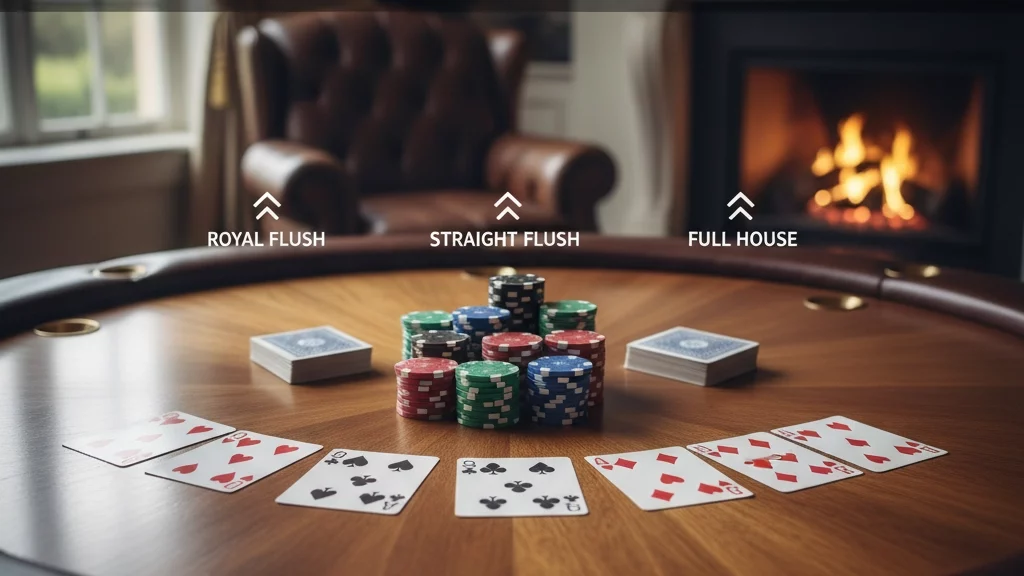
The official poker hand rankings (from best to worst)
All major poker variants use the same hierarchy of hands. Memorize these so you instantly recognize what beats what.
- Royal Flush: A, K, Q, J, 10 of the same suit — the unbeatable top hand.
- Straight Flush: Five consecutive cards of the same suit (e.g., 7-8-9-10-J of hearts).
- Four of a Kind (Quads): Four cards of the same rank (e.g., 9-9-9-9 plus any fifth card).
- Full House: Three of a kind plus a pair (e.g., Q-Q-Q and 6-6).
- Flush: Any five cards of the same suit, not in sequence (e.g., A-7-5-3-2 of spades).
- Straight: Five consecutive cards of mixed suits (e.g., 4-5-6-7-8).
- Three of a Kind (Trips/Set): Three cards of the same rank (e.g., J-J-J plus two unrelated cards).
- Two Pair: Two different pairs (e.g., K-K and 4-4 with an extra card).
- One Pair: Two cards of the same rank (e.g., 10-10 plus three unrelated cards).
- High Card: When no one has any of the above, the highest single card wins (e.g., A-high).
Key details that determine which hand wins
Two hands of the same category are compared by their ranks and, if needed, kickers:
- Highest rank within the category: A pair of kings beats a pair of queens.
- Kickers: When the main combination ties (e.g., both have a pair of 10s), the highest unrelated card(s) decide the winner.
- Suit rules: In most games suits don’t have rank; ties are decided by card ranks and kickers, not suits.
How to judge hand strength in real time
Knowing the ranking list isn’t enough — you must evaluate strength relative to the board and opponents. Think about absolute versus relative strength: an ace-high flush is strong in isolation (absolute), but if the board pairs and an opponent shows a full house, your flush is weak relative to the situation.
- Consider board texture: Coordinated boards (connected or same-suit cards) create many straights and flushes — be cautious.
- Assess drawing potential: A hand with many outs (cards that improve it) has value even if it’s currently behind.
- Watch betting patterns: Aggression often signals strong made hands or strong draws; passive play can indicate weakness.
With these fundamentals in place, you’ll recognize hand categories instantly and begin reading strength in context. In the next section, you’ll see worked examples and learn how to apply rankings to popular poker variants and common in-game situations.
Worked examples: reading hands on the flop, turn and river
Practical examples are the fastest way to turn rankings into usable table sense. Below are three common situations and exactly how to judge strength, count outs, and make the right decision.
Example A — Nut flush draw plus overcards (Texas Hold’em)
– Your hand: A♠ K♠
– Flop: 8♠ 5♠ 2♦
Assessment:
– You already have the nut flush draw (four spades: two in your hand, two on board) and two overcards to any non-spade pair on board.
– Outs: 9 spades remain in the deck (13 spades total − 4 known spades = 9 outs).
– Rough probabilities: From flop to river (two cards to come) use the 4× rule: 9 outs × 4 ≈ 36% to make a flush by the river. From turn to river (one card) use 2×: 9 × 2 ≈ 18%.
How to play:
– This hand has strong drawing value and showdown equity. If pot odds and implied odds are reasonable, calling or raising for fold equity is appropriate. Beware paired boards on the turn/river — a paired board can allow someone to make a full house and suddenly your flush is behind.
Example B — Middle set on a coordinated board
– Your hand: 7♦ 7♣
– Board after river: J♣ J♦ 7♠ 2♣ 3♠
Assessment:
– You have trips (three of a kind) by the river. That’s strong, but the board texture matters: two unpaired low cards with paired jacks on the board make a full house possible for opponents who held Jx or JJ.
How to play:
– Value-bet against single-pair hands and bluffs, but be cautious against significant aggression from the turn to river — large raises often indicate a full house (Jx) or quads. When in doubt, size your bets to charge drawing hands while preserving fold equity.
Example C — Blocking and kicker considerations
– Your hand: 10♠ 10♥
– Board: 10♦ 8♣ 4♣ K♠ Q♣
Assessment:
– You have trips (three tens). If an opponent holds KQ, they have two pair (Kings and Queens) and would beat your trips? No — trips beat two pair. But if the board pairs (e.g., another K appears), full houses are possible.
– Kickers matter when both players have the same trips formed by a single board card: if both players use a board trip and their hole cards include a higher kicker that matters for five-card ranking, the kicker can decide close showdowns.
How to play:
– With trips on a dry board, bet for value. On dynamic boards, slow-play carefully to avoid giving free cards that complete stronger hands.
Applying rankings to popular poker variants
Different variants use the same hand-ranking hierarchy but change how hands are formed and how often certain hands occur. Knowing these differences changes strategy.
Texas Hold’em (most common)
– Best five cards are made from any combination of your two hole cards and five community cards.
– Typical considerations: missing draws are common; read board texture and opponent range. Because only two hole cards exist, made hands and draws show up with moderate frequency — play accordingly (value-bet made hands, semi-bluff draws).
Omaha (Hi and Hi-Lo)
– Each player receives four hole cards and must use exactly two of them plus exactly three community cards.
– Consequence: hand values run higher — straights and flushes are more frequent, and nut hands are more important. A “flush” you beat in Hold’em can be second-best in Omaha if an opponent uses different hole cards. Always consider that opponents likely have more combinations to make strong hands.
– Example: Holding A♠ K♠ Q♠ J♠ in Omaha doesn’t guarantee the nut flush because you must combine exactly two hole cards with three board cards; the specific composition matters.
Seven-Card Stud
– There are no community cards. Each player receives seven cards (some face up), and the best five-card hand wins.
– Use visible upcards to narrow opponent ranges. Because more cards are known, draws and blockers become very readable — adjust bets when opponents’ upcards complete likely straights/full houses.
Across variants, the same ranking rules apply, but frequency, blocker effects, and required combinations change the practical strength of hands. Train yourself to translate the ranking list into variant-specific reads: ask “How likely is my opponent to have the hand that beats me given the rules and the visible cards?” and let that answer the bet/fold/call decision.
Putting hand rankings into practice
Knowing the ranking list is just the first step — the real skill is applying it quickly under pressure. Practice counting outs, comparing board textures, and thinking in ranges instead of single hands. Use small-session drills: review hands after play, note where you misread a board, and track how often draws complete. Build habits that speed up assessment (outs → rough probability → pot odds) so the correct decision becomes automatic.
- Start with low-stakes games to turn theory into instincts without risking much bankroll.
- Use hand-history reviews and simple odds tools to check your reads and learn from mistakes — many sites provide free calculators and breakdowns; try CardPlayer’s Odds Calculator.
- Focus on pattern recognition: common flop/turn textures, typical drawing ranges, and how different variants change hand frequency.
Frequently Asked Questions
How do ties get resolved when both players have the same type of hand?
If both players have the same hand ranking, the winner is decided by the highest-ranking cards that make up the five-card hand. Compare the top card(s) in order until a difference appears (kickers matter). If all five cards are identical in rank, the pot is split. Suits do not rank hands in standard poker variants.
How do I count outs correctly on the flop and turn?
Outs are unseen cards that improve your hand to a likely winner. Count unique cards that complete your draw (avoid double-counting cards that help multiple draws). To estimate probability roughly: from flop to river (two cards) multiply outs × 4; from turn to river (one card) multiply outs × 2. For precise odds, use an odds calculator or combinatorics.
Are poker hand rankings the same across Hold’em, Omaha, and Stud?
Yes — the hierarchy (royal flush down to high card) is the same. What changes is how easily certain hands appear and the rules for forming a hand (e.g., Omaha requires exactly two hole cards + three board cards). That difference affects strategy: in Omaha nut hands and blockers are more crucial, while visible upcards in Stud give extra information for narrowing ranges.