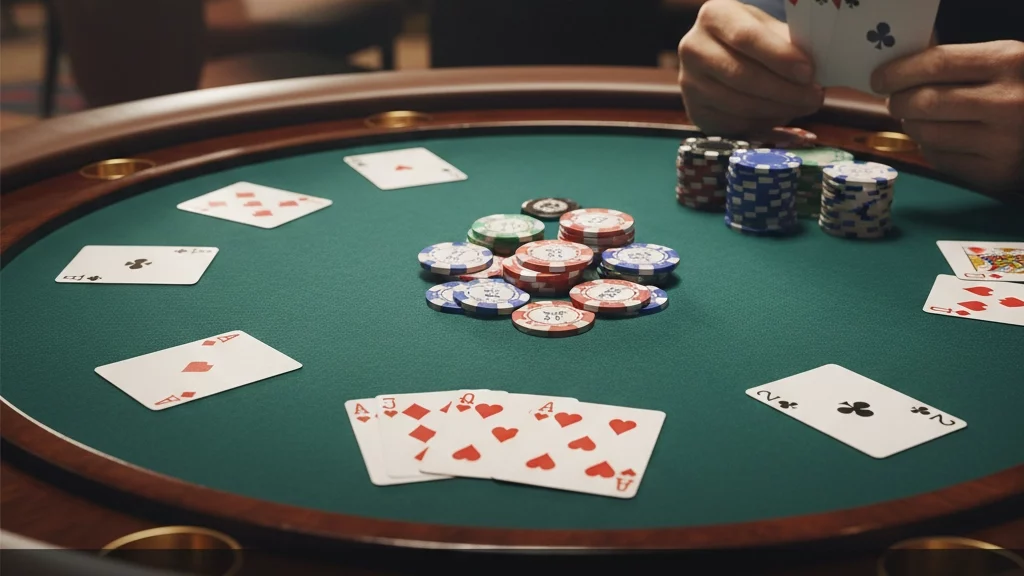
Master poker hand strength: Rules every player must know

Why knowing hand strength is the foundation of every winning decision
You can study tells, position, and bet sizing all day, but if you don’t instantly recognize how strong your hand is relative to the table, your decisions will be guesses. Hand strength is the baseline metric that informs whether you should bet, call, raise, or fold. By training yourself to assess absolute value (what your cards are worth alone) and relative value (what they are likely worth against opponents), you reduce mistakes and extract more chips when you’re ahead.
Start by practicing quick, repeatable checks: identify your best five-card combination, compare it to common board textures, and estimate how many hands beat you. Those three checks turn an emotional reaction into a consistent decision process that you can apply from micro-stakes cash games to tournament bubbles.
Memorize the essential ranking and what each level really means in play
You should be able to name, in order, every standard poker hand and what it represents without hesitation. Below is a practical breakdown focused on in-game implications rather than textbook definitions.
- Royal flush — The absolute nuts: A, K, Q, J, 10 of the same suit. Practically unbeatable; rarely relevant in decision-making beyond betting for value.
- Straight flush — Five consecutive cards of the same suit. Extremely strong—if you have one, play aggressively unless the board makes higher straights possible.
- Four of a kind — Very few hands beat this; use it to extract maximum value from players chasing full houses or trips.
- Full house — Three of a kind plus a pair. Powerful, but beware of board pairings that can upgrade opponents’ hands to full houses or quads.
- Flush — Five cards of the same suit. Strong on dry boards; on coordinated boards it can be vulnerable to straights and full houses.
- Straight — Five consecutive ranks. Good, but pay attention to whether the board makes higher straights possible or if flushes can beat you.
- Three of a kind (Trips/Set) — Solid, especially when disguised. A set (pocket pair then matching board card) is stronger than trips made with one card on the board and one in hand.
- Two pair — Decent but common. Vulnerable to trips and full houses; position and kicker strength matter.
- One pair — The baseline made hand. Often worth protecting with aggressive play in position but easy to fold to heavy action on coordinated boards.
- High card — No pair; often a bluffing or drawing situation unless both players miss—then kicker matters.
How board texture and opponent tendencies change a hand’s value
You must evaluate hand strength in the context of the board. A flush on a two-tone, uncoordinated board is usually very strong; the same flush on a paired, connected board loses value because opponents can make full houses or better straights. Also factor in betting patterns: a sudden large raise on the river often indicates a stronger range than a single caller showing passive lines.
With these basics locked in, you’ll be ready to apply range thinking and expected value calculations to your hand assessments. In the next section you’ll learn how to compare your hand to opponent ranges and convert strength into correct betting decisions.
Compare your hand to an opponent’s range — not a single hand
One of the biggest mistakes players make is sizing up their hand against one villain hand (e.g., “He has a pair of queens”) instead of the range of hands he could plausibly have. Ranges are built from the actions you see: preflop position and sizing, flop/turn aggression, and the timing of bets. Start with broad categories (premium, broadway, suited connectors, small pairs) and narrow them as the hand develops.
Practical steps: first, assign a basic preflop range for the raiser based on seat and stack size. Second, remove hands that wouldn’t take the line you observed — a passive check on the flop rules out many bluffs and strong made hands that would protect. Third, weight the remaining hands by frequency: a preflop 3-bettor will have more strong aces and broadways than a limp-caller. Use blockers: if you hold the ace of spades and the board pairs spades, opponents are less likely to hold nut flushes.
With a rough range in mind you can estimate equity — does your hand beat a large share of that range, a small share, or just the bottom? You don’t need exact percentages to act well; mental heuristics work: if you’re ahead of most of the range, lean toward value; if you’re only beating bluffs or a tiny fraction, avoid large commitments. Off-table study with equity calculators will tighten your instincts, but at the table practice reducing possibilities quickly and updating ranges after each action.
Convert strength into lines and bet sizes: a practical playbook
Once you know roughly where your hand sits in the opponent’s range, translate that into a line that maximizes expected value.
– Nuts and near-nuts: bet for value and protect. Use larger sizing on draw-heavier boards to charge equities. If the board allows a higher nut (rare), consider sizing to deny implied odds to drawing hands.
– Strong but vulnerable (top pair weak kicker, single-suited flush on connected board): prefer smaller bets or pot control lines unless you can extract thin value. Check-call small bets to keep bluffs in, or bet small to fold out overcards.
– Medium-strong (sets, two pair): aim to extract while denying free cards. Bet sizes between half pot and full pot work well to charge draws and thinner pairs; consider check-raises when you want to price opponents into mistakes.
– Marginal hands and bluffs: polarize your river range when appropriate. Successful bluffs need fold equity — size them so folding is profitable for a wide portion of villain ranges. Use blockers when choosing bluff targets (e.g., holding an ace blocks many value combinations).
– Showdown value and bluff-catching: call river with hands that beat bluff-heavy parts of the opponent’s range and that get the pot odds offered. If a bet only fares well against two-card bluffs, fold unless the pot odds justify the call.
Always adapt sizing to opponent tendencies. Calling stations require bigger thin-value bets; fold-prone opponents deserve pressure. By consistently mapping hand strength to specific lines — bet big with domination, pot control with vulnerability, and exploitative bluffs when fold equity is high — your absolute knowledge of hand rankings becomes actionable and profitable.
Putting knowledge into practice
Mastering hand strength is less about memorizing rules and more about consistent application: deliberate practice, targeted study, and honest review of your decisions. Build short, repeatable routines (preflop range assignment, flop-range update, sizing decision) and make them automatic. Use hand reviews to spot recurring mis-evaluations, then drill specific situations — e.g., playing top pair with weak kicker on draw-heavy boards or bluff-catch frequency on the river.
- Practice with tools: run spot equity checks off-table to calibrate heuristics and use HUDs or note-taking for pattern recognition. Try the Equilab poker equity tool for range vs. range work.
- Set short learning goals: 30 hands focused on one adjustment (bet sizing on wet boards, range narrowing after checks) rather than diffusing effort across everything.
- Review and adjust: after each session, tag two mistakes and two correct reads. Reinforce what worked and create a plan to eliminate the errors.
- Mindset: prioritize process over short-term results. Correctly applying range-thinking and sizing decisions will produce profitably over time even if individual sessions vary.
Make practice structured, feedback-driven, and frequent. Over time the rules and heuristics that felt abstract will become instinctive tools you apply automatically at the table.
Frequently Asked Questions
How do I estimate an opponent’s range quickly in real time?
Start with a simple preflop range based on seat, action, and stack sizes (e.g., early-position open vs. late-position steal). Narrow it using actions: a passive check reduces strong value hands; a large raise increases premium combinations. Weight by tendencies (tight/loose, aggressive/passive) and use blockers from your own cards to rule out obvious combinations. Practice with timed drills to speed up the process.
When should I choose pot control instead of betting for value?
Choose pot control when you hold a vulnerable but decent hand (top pair with weak kicker, second pair on coordinated board) and the board favors draws or stronger two-card combinations. If you can’t comfortably deny equity to many drawing hands with a single bet, smaller sizing or checking to keep the pot manageable preserves long-term value while avoiding commit mistakes.
How do blockers influence bluffing and value decisions?
Blockers are cards you hold that reduce the number of strong combinations an opponent can have (e.g., an ace blocking many nut combinations). Use them to select better bluff targets—if you hold a card that eliminates key value hands, your bluffs are more credible. Conversely, when you have blockers to the nuts, you may thin-value bet more confidently because opponents have fewer nut hands to exploit you.