Browsed by
Author: Ryan Patterson

Poker hand strength in tournaments: Rules and survival tips

Poker hand strength in tournaments: Rules and survival tips

Why hand strength in tournaments is different from cash games In tournaments you’re not just playing a hand against the table — you’re playing the clock, the payout ladder, and a shifting chip economy. You need to think beyond raw card rankings and evaluate how your hand performs relative to stack sizes, blinds, antes, and stage-specific incentives. Understanding this will let you make decisions that keep you alive longer and increase your chance of climbing the payout structure. Core factors…


Read More Read More

Heads-up poker hand strength: Rules and adjustments to make

Heads-up poker hand strength: Rules and adjustments to make

Why you must rethink hand strength when playing heads-up Heads-up poker is a different animal compared with full-ring or six-max games. With only one opponent, the absolute strength of hands shifts: hands that are marginal multiway suddenly become functional tools, and premium holdings have less relative dominance because your opponent has a much wider range. You need to stop thinking in fixed “hand tiers” and start evaluating hands by relative equity, position, and postflop playability. In practice this means you’ll…

Read More Read More

Poker hand strength: Complete guide to poker rules for beginners

Poker hand strength: Complete guide to poker rules for beginners

Why understanding hand strength changes how you play poker When you sit at a poker table, the single most important skill you can develop is evaluating hand strength. Knowing which hands beat others and how the community cards affect your odds helps you decide when to bet, fold, or bluff. This guide teaches you the core rankings and practical rules so you can make smarter choices whether you’re playing Texas Hold’em, Omaha, or another common variant. Hand strength isn’t just…

Read More Read More

Poker Rules: Learn Poker Hand Strength & Rankings

Poker Rules: Learn Poker Hand Strength & Rankings

Why understanding poker hand rankings changes how you play When you sit at a poker table, every decision — whether to bet, call, raise, or fold — depends on how strong your hand is relative to the possible hands your opponents might have. By learning the standardized hand rankings and how to read strength in context, you’ll stop guessing and start making informed choices. This section explains the order of hands and the basic concepts you’ll use every time you…

Read More Read More

Improve poker hand strength assessment: Rules, tips, and practice

Improve poker hand strength assessment: Rules, tips, and practice

Why precise hand-strength assessment changes your results You win at poker by making better decisions than your opponents. Central to every decision is an accurate read of how strong your hand is relative to the likely hands at the table. If you overestimate your hand you call when you should fold; if you underestimate it you fold when you could extract value. Learning a repeatable process for assessing strength reduces guesswork and gives you a framework to decide whether to…

Read More Read More

Printable poker hand strength chart: Rules for quick reference

Printable poker hand strength chart: Rules for quick reference

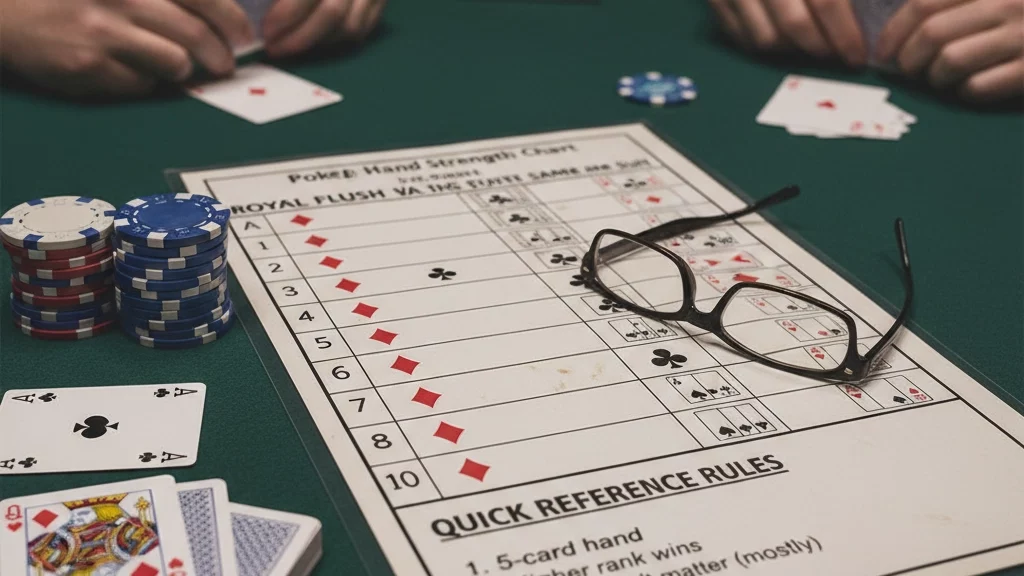
Why a printable poker hand strength chart speeds up your decisions You want to make faster, more consistent choices at the poker table, whether you’re playing live or online. A printable poker hand strength chart gives you a visual shortcut: it reduces complex probabilities into a readable layout so you can evaluate starting hands, post-flop ranges, and quick odds without doing math under pressure. When you rely on a chart correctly, you remove guesswork and focus on position, pot size,…

Read More Read More

Reading opponents with poker hand strength: Rules-based tells

Reading opponents with poker hand strength: Rules-based tells

Why accurate hand-strength reads change how you play You can’t see your opponents’ cards, but you can build reliable estimates of their hand strength by following simple, consistent rules. These rules-based tells let you convert observable actions — bet size, timing, lane of aggression, and sequencing — into probabilities you can act on. When you learn to map patterns to likely ranges instead of committing to a single “guess,” you make more +EV decisions: better folds, value bets, and well-timed…

Read More Read More

How table position affects poker hand strength and poker rules

How table position affects poker hand strength and poker rules

Why your seat changes the practical strength of a poker hand Your physical seat at the table—whether you act early, in the middle, or on the button—directly changes how strong a particular hand is in practice. Two cards that look identical on paper can play very differently depending on when you act. When you act early, you must commit to decisions without seeing how most opponents respond; acting last gives you the informational advantage of seeing other players’ actions before…

Read More Read More

Poker hand strength FAQs: Common rules and ranking questions

Poker hand strength FAQs: Common rules and ranking questions

Understanding poker hand strength: why rankings matter at every table When you sit down to play poker, the single most important thing to know is how hands are ranked. Hand strength determines who wins a pot, how much you should bet, and when you should fold. You don’t need to memorize every statistic, but you do need to be fluent in the ranking order and the basic rules that decide ties and unusual situations. This guide answers the questions players…

Read More Read More

Family poker variations and poker hand strength rules compared

Family poker variations and poker hand strength rules compared

Why family poker games often use different hand-strength rules than formal poker When you play poker at home, the goal is usually social fun rather than strict competition. That means you’ll frequently encounter rule changes that affect hand strength: wild cards, lowball options, stripped decks, or special “show” rules designed to speed play or reward creativity. You should understand why these departures exist so you can decide which changes improve your game and which will cause confusion or unfairness. Family…

Read More Read More