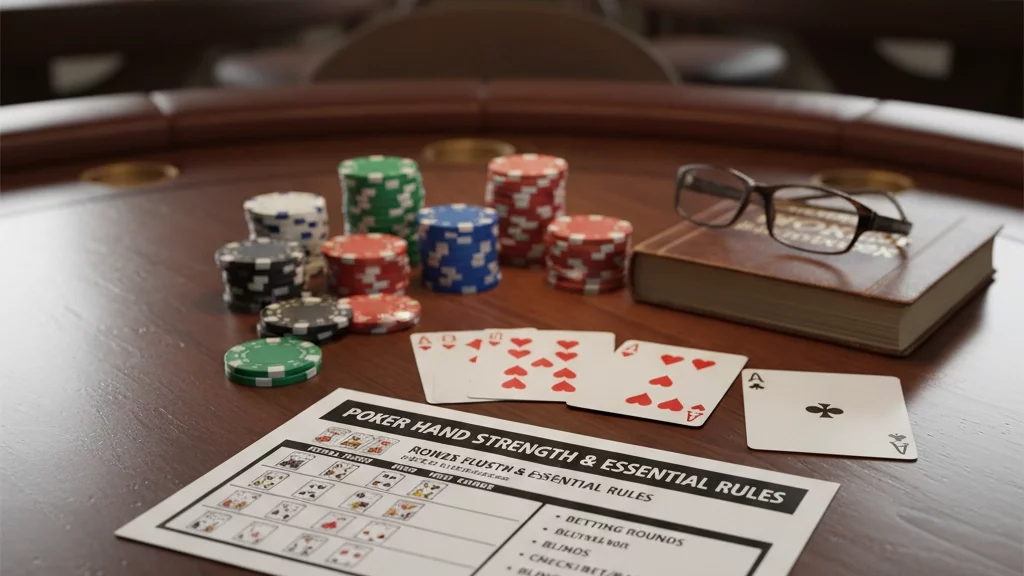
Quick poker hand strength cheat sheet and essential poker rules
Why knowing hand strength gives you an edge at the table
You don’t need to memorize every probability to play good poker, but you do need a fast mental map of which hands beat which. When you can quickly rank hands and remember the basic table rules, you’ll make faster, more confident decisions — from whether to open a pot preflop to how aggressively to defend your blinds. The quick cheat sheet below lists the standard poker hand rankings and shortnotes you can recall in pressure moments.
Poker hand rankings — strongest to weakest (quick cheat sheet)
- Royal Flush — A, K, Q, J, 10 of the same suit. The unbeatable top of the straight-flush family.
- Straight Flush — Five consecutive cards of the same suit (e.g., 9♣–8♣–7♣–6♣–5♣). Beats all other hands except a higher straight flush or royal.
- Four of a Kind (Quads) — Four cards of the same rank (e.g., K♦–K♣–K♥–K♠). Very strong; kicker can matter in rare split-pot scenarios.
- Full House — Three of a kind plus a pair (e.g., 8♠–8♥–8♦ and 4♣–4♥). Ranked by the trip value first, then the pair.
- Flush — Any five cards of the same suit, not consecutive (e.g., A♣–J♣–9♣–6♣–3♣). High-card determines winners between flushes.
- Straight — Five consecutive cards in different suits (e.g., 10♠–9♦–8♥–7♣–6♦). Ace can be high or low (A–K–Q–J–10 or 5–4–3–2–A).
- Three of a Kind (Trips) — Three cards of the same rank (e.g., 5♣–5♦–5♥). Kickers decide ties.
- Two Pair — Two different pairs (e.g., Q♦–Q♠ and 7♥–7♣). The higher pair wins if both players have two pair.
- One Pair — Two cards of the same rank (e.g., 10♣–10♦). Remaining cards (kickers) determine ties.
- High Card — When no one has a pair or better, the highest card wins (e.g., A–K–9–6–2).
Essential table rules and actions to play correctly from the first hand
Beyond ranking hands, you must understand basic rules and legal actions so you don’t lose chips from rule violations or confusion. The most common variant you’ll play is Texas Hold’em; these essentials apply there and translate to many other games.
Positions, blinds, and the flow of betting
- Dealer button: Moves clockwise each hand and determines positional advantage; acting last after the flop is powerful.
- Blinds: Small blind and big blind are forced bets to seed the pot; they rotate with the button.
- Betting rounds: Preflop, flop (3 community cards), turn (4th card), river (5th card). You can fold, check (if no bet), call, or raise during each round.
- Showdown: After the final betting round, remaining players reveal hands; the best-ranked hand using the rules above wins the pot.
With these rankings and table rules solid in your mind, you’re ready to start applying them to preflop hand selection and simple postflop decisions — the next section will show practical preflop ranges and quick decision rules you can use immediately.
Practical preflop ranges — simple rules for beginners
Preflop selection is the single biggest lever for improving results quickly. You don’t need complicated charts at the table — use tight-but-flexible rules based on your position.
- Early position (UTG, UTG+1): Play tight. Open with premium hands only — AA–99, AK, AQ suited. Fewer hands means fewer difficult postflop spots.
- Middle position: Add broadway hands and stronger suited connectors: TT–88, AJs–ATs, KQs, and suited connectors like JTs occasionally.
- Late position (cutoff, button): Open much wider. You can steal with Axs, Kx suited, most broadways, and suited connectors (98s–54s). Positional advantage makes these profitable.
- Blinds: Defend selectively. Call wider vs late-position opens, but tighten vs early-position raises. Defend with strong broadways, suited aces, medium pairs, and some suited connectors if pot odds and position are acceptable.
- 3-betting: Use it for value (JJ+, AK) and as a polarized tool with bluffs (A5s, KQs, suited connectors) — but don’t overdo it until you’re comfortable reading opponents.
- Set-mining: Call preflop with small/medium pairs only if you or your opponent will call a reasonable raise postflop and stacks are deep enough (rough rule: 12–15x the raise remaining).
These are guidelines, not rigid laws. The key is to tighten in early positions and widen on the button, adjusting to table tendencies (loose vs tight opponents).
Quick postflop decision rules — a practical checklist
After the flop, follow a short mental checklist to make faster, better decisions under pressure.
- Assess the board texture: Dry boards (A‑7‑2 rainbow) favor continuation bets; coordinated/wet boards (J‑T‑9 with two suits) give draws and combos to worry about.
- Where’s your equity? Do you have a made hand, a strong draw, or just overcards? Use the Rule of 4 and 2 to estimate your chance to hit: outs ×4 from flop to river, outs ×2 from turn to river (approximate %).
- Consider ranges, not just cards: Think about what hands your opponent could have based on preflop and betting. Are they capped (weak) or representing strength?
- Bet sizing guidance: Small c-bets (25–40% pot) work on dry boards; larger bets (50–75%) are better on wet boards to charge draws. When out of position, prefer more frequent folds or pot control with marginal hands.
- Semi-bluff vs pot control: Bet your draws when you have fold equity; check/raise as a bluff only if the opponent folds enough. With medium-strength hands, check and call or seek cheap showdowns rather than bloating the pot.
Common beginner mistakes and simple fixes
- Mistake: Playing too many hands from early position. Fix: Tighten up early; widen only from late position.
- Mistake: Calling too often (the “calling station”). Fix: Learn to 3-bet or fold — passive calls waste chips and give opponents good pot odds.
- Mistake: Ignoring position. Fix: Prioritize position — it’s often worth folding a marginal hand out of position and playing it strongly on the button.
- Mistake: Over-bluffing or slow-playing unnecessarily. Fix: Use aggression selectively; value-bet your strong hands and bluff when your image and table dynamics support it.
- Mistake: Forgetting stack sizes. Fix: Always note effective stacks; they change whether set-mining, shove/fold decisions, or multi-street bluffs are correct.
Apply these practical rules and you’ll reduce costly mistakes while building a reliable framework for more advanced moves as you gain experience.
Practice drills to build instinct
Turn the rules above into habits with short, focused practice sessions. Spend 15–30 minutes on specific drills rather than trying to study everything at once.
- Drill preflop: Sit at a table (real or simulator) and force yourself to only open the recommended ranges for each position for 30 hands.
- Drill postflop: Play small pots where you practice sizing choices on dry vs wet boards — bet small on dry, larger on wet, and note outcomes.
- Drill fold discipline: Track hands where you called and later realized you should have folded; aim to reduce one bad calling habit per week.
- Review sessions: After each session, review 10 hands and ask whether position, stack size, and hand range reasoning were applied correctly.
Next steps for improvement
Make steady, deliberate practice your priority: focus on one concept at a time, review hands critically, and adjust based on what your opponents are doing. Use quality learning resources to reinforce fundamentals — for clear tutorials and drills, see PokerStars Strategy. Keep your sessions short, track progress, and stay patient — improvement compounds quickly when you work consistently.
Frequently Asked Questions
How tight should I play in early position?
Play tightly in early position: stick mostly to premium pairs (AA–99) and strong broadways like AK and AQ suited. Early position opens more difficult postflop spots, so fewer hands reduce costly mistakes.
When is a 3-bet the right play instead of just calling?
3-bet for value with strong hands (JJ+ and AK) and use polarized 3-bets with select bluffs when opponents fold enough. Call when you want to keep weaker hands in and avoid bloating pots out of position; factor in opponent tendencies and stack sizes.
How do I decide whether to continue with a drawing hand postflop?
Estimate your equity with the Rule of 4 and 2 (outs ×4 from flop to river, ×2 from turn to river), compare to the pot odds, and include implied odds and fold equity. Fold if the math and opponent behavior don’t justify calling; semi-bluff when you have fold equity or strong redraws.