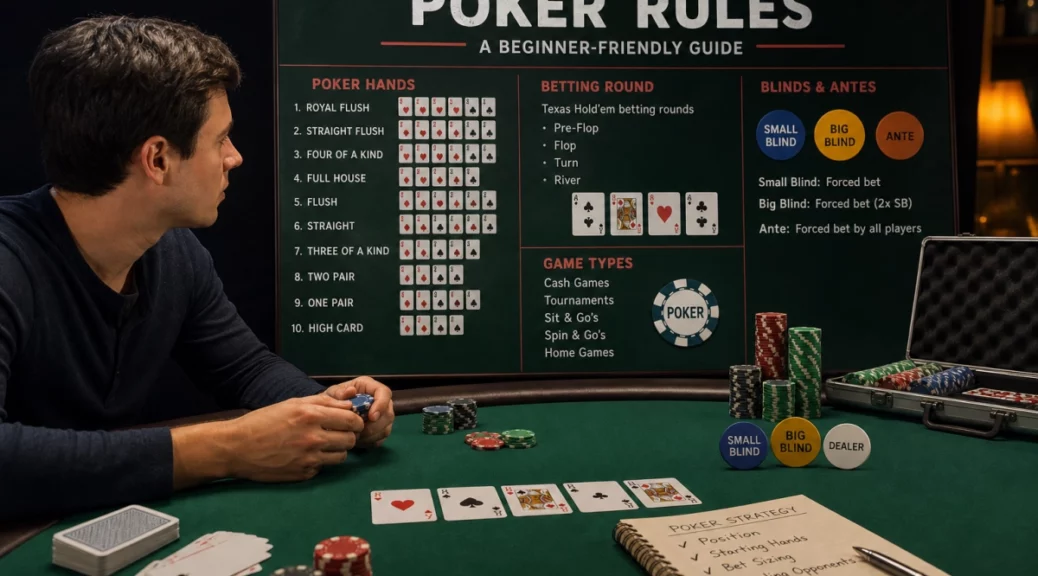
Poker Rules Explained: Beginner-Friendly Guide to Hands, Betting, Blinds & Game Types
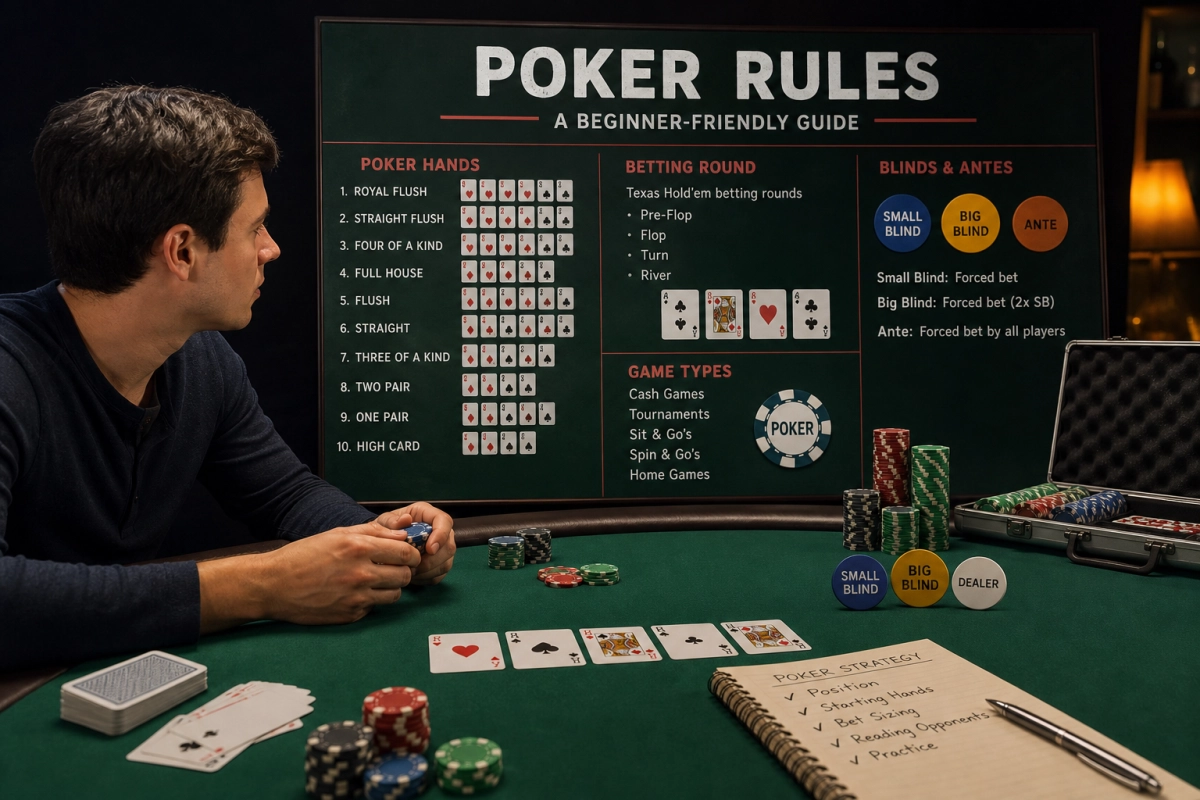
How poker rules work: a clear start for beginners
This guide explains poker rules in plain language so new players can learn hand rankings, betting rounds, blinds and antes, showdown procedures and essential table rules. It focuses on the fundamentals common to most poker variants (especially Texas Hold’em, Omaha and Seven‑Card Stud) and prepares readers for the game-specific differences that follow in the next part.
Poker hand rankings — which hands beat which
Hand rankings determine the winner at showdown. Hands use standard 52-card deck rankings: A (ace) is high unless needed low for specific straights. From highest to lowest:
- Royal flush — A♠ K♠ Q♠ J♠ 10♠: the top straight flush.
- Straight flush — Five consecutive cards, same suit (e.g., 7♥ 6♥ 5♥ 4♥ 3♥).
- Four of a kind (quads) — Four cards of the same rank (e.g., J♣ J♦ J♥ J♠).
- Full house — Three of a kind plus a pair (e.g., 8♦ 8♣ 8♠ + 4♥ 4♣).
- Flush — Any five cards of the same suit, not consecutive.
- Straight — Five consecutive ranks in mixed suits.
- Three of a kind (set or trips) — Three cards of the same rank.
- Two pair — Two different pairs.
- One pair — Two cards of the same rank.
- High card — When no one has any of the above, highest card wins.
Ties are usually broken by the next highest card(s), called kickers. If two players have identical five-card hands, the pot is split.
Betting rounds, blinds and antes — the basic flow of a hand
Most popular poker games follow a series of betting rounds where players act in turn. Understanding these rounds and common betting options is essential to applying poker rules at any table.
Common betting rounds (example: Hold’em/Omaha)
- Pre‑flop — After hole cards are dealt, the first betting round begins.
- Flop — Three community cards are dealt; second betting round.
- Turn — Fourth community card; third betting round.
- River — Fifth community card; final betting round.
- Showdown — Remaining players reveal hands; best hand wins the pot.
Blinds, antes and common betting actions
- Blinds — Mandatory forced bets (small and big blind) posted by two players to create an initial pot; common in Hold’em and Omaha.
- Antes — Small contribution from every player before the hand; common in later tournament stages and some cash games.
- Betting options — Check (pass action), bet (put chips in), call (match a bet), raise (increase the bet), fold (give up the hand).
- Table stakes — Players may only bet chips on the table at the start of a hand; they cannot reach into pockets to add more during it.
Showdown procedures include revealing hole cards in turn and awarding the pot to the best qualifying hand. Side pots occur when one or more players are all‑in with different stack sizes.
Responsible play advice: players should set a budget, understand that poker involves chance, and avoid treating it as guaranteed income.
Next, the guide will compare how these poker rules change across Texas Hold’em, Omaha and Seven‑Card Stud, and explain cash vs tournament differences plus online vs land‑based specifics.
How rules differ across Texas Hold’em, Omaha and Seven‑Card Stud
Many core concepts—betting rounds, hand rankings, table stakes—stay the same, but each variant changes how cards are dealt, how hands are made and sometimes the betting format.
- Texas Hold’em — Each player receives two private “hole” cards. Five community cards are dealt in three stages (flop, turn, river). Players make the best five‑card hand using any combination of their two hole cards and the five community cards (so you may use one, two or none of your hole cards). Most widely played in no‑limit format but also common in limit and pot‑limit.
- Omaha — Players get four hole cards and five community cards are dealt like Hold’em. Crucially, a legal Omaha hand must use exactly two hole cards plus exactly three community cards. This rule makes hand values and drawing dynamics very different from Hold’em: draws are often stronger and nut hands change. Omaha is most commonly played as pot‑limit (PLO). Variants include Omaha Hi‑Lo (split pot when a qualifying low exists), which adds split‑pot rules and low‑hand qualification (usually “8 or better”).
- Seven‑Card Stud — No community cards. Each player receives seven cards total over several rounds (three down, four up), with betting between deals. The initial forced contribution is usually a small bring‑in instead of blinds, and the bring‑in is posted by the lowest upcard. Stud is commonly played with fixed limits, though mixed limit games exist. Because many cards are exposed, hand reading and memory are more important than in community‑card games.
Other practical differences: betting structure often matches the variant (no‑limit for Hold’em, pot‑limit for Omaha, fixed‑limit for Stud historically). Also watch variant‑specific rules like multiway low qualifications in Hi‑Lo games and whether exposed cards in Stud can be mucked or must be tabled at showdown.
Cash games vs tournaments — what changes for rules and play
Cash games and tournaments share the same hand rules, but many operational and strategic rules differ:
- Chip meaning — In cash games chips equal real money and can be bought/sold at the table. In tournaments chips are tournament units only; you cannot cash them in except by finishing in the money.
- Buy‑ins and rebuys — Cash games let you buy in within table limits and top up between hands. Tournaments may be freezeouts (no rebuys) or allow rebuys/add‑ons during registration; once eliminated in most tournaments you’re out unless you rebuy.
- Blinds/antes — In cash games blinds are fixed to the stakes; in tournaments blinds and antes rise on a schedule to accelerate action and eliminate players. This changes strategy (short‑stack survival in tournaments versus deep‑stack play in cash games).
- Payouts and structure — Tournaments pay according to a prize structure (top‑heavy or flatter), introducing ICM (independent chip model) decisions near the bubble. Cash game winners take the pot immediately and can leave whenever they wish.
- Rules enforcement — Tournaments often have stricter timing (shot clocks, penalties) and format rules (table consolidation, breaks).
Online vs land‑based specifics — what to expect at your first table
Online and live play use the same poker fundamentals, but expect important differences in pace, tools and house rules.
- Speed and multi‑tabling — Online play is much faster; actions are instantaneous and many players play multiple tables. Live play is slower, with verbal declarations, physical chip moves and human timing.
- Interface and protections — Online sites use RNGs, offer hand histories, auto‑muck options and time banks. They also enforce anti‑collusion and automatic seat options. Land‑based casinos enforce rules via dealers and the floor—expect more emphasis on etiquette, visible cards and resolving disputes in person.
- Rake and fees — Rake structures differ: online rakes may be lower but include time‑based tournament fees; casinos often take a percentage pot rake with caps and may add seat charges or timed table fees.
- Etiquette and rule nuances — Live games require awareness of string bets, exposing cards, verbal declarations and table etiquette; online you must manage disconnects, auto‑mucks and software features. Always read the house or site rules before you play.
These contrasts affect both how you play and what rules you must follow—understanding them helps you transition between formats with confidence.
Getting started: a short checklist
- Play low‑stakes or free games first to learn pace and etiquette without pressure.
- Read the house or site rules before joining a table so you know specific procedures and penalties.
- Practice basic bankroll management: set a limit, stick to it, and never chase losses.
- Review hands after sessions — note mistakes and patterns to improve decision‑making.
- Prioritize patience, position awareness and simple odds rather than complex strategies at the start.
- Keep play social and responsible: take breaks, limit sessions, and treat losses as part of learning.
Final thoughts
Poker rewards patience, observation and steady practice. Expect to learn progressively: small mistakes and awkward situations are part of the process. Focus on playing within your means, learning the specific rules at each table you join, and enjoying the social and competitive aspects of the game. With time and consistent practice, the rules will feel natural and your decisions will become clearer — the rest is experience.