Beginner Guide to Poker Rules: Texas Hold’em, Omaha & Seven-Card Stud
Simple poker rules for beginners: what this guide teaches
This guide explains the core poker rules beginners need to play Texas Hold’em, Omaha and Seven‑Card Stud. It covers hand rankings, the basic betting actions (check, call, raise, fold), blinds and antes, and the structure of betting rounds. The goal is to make rules clear so players can sit at a cash game or table tournament with confidence. Later sections will compare live and online play and cover side pots, showdowns and common rule mistakes.
Which games share the same poker rules — and where they differ
Many rules are shared across poker variants: making the best five-card hand from available cards, acting in turn, and following a set betting structure. Differences appear in how many hole cards players receive and how community cards are used:
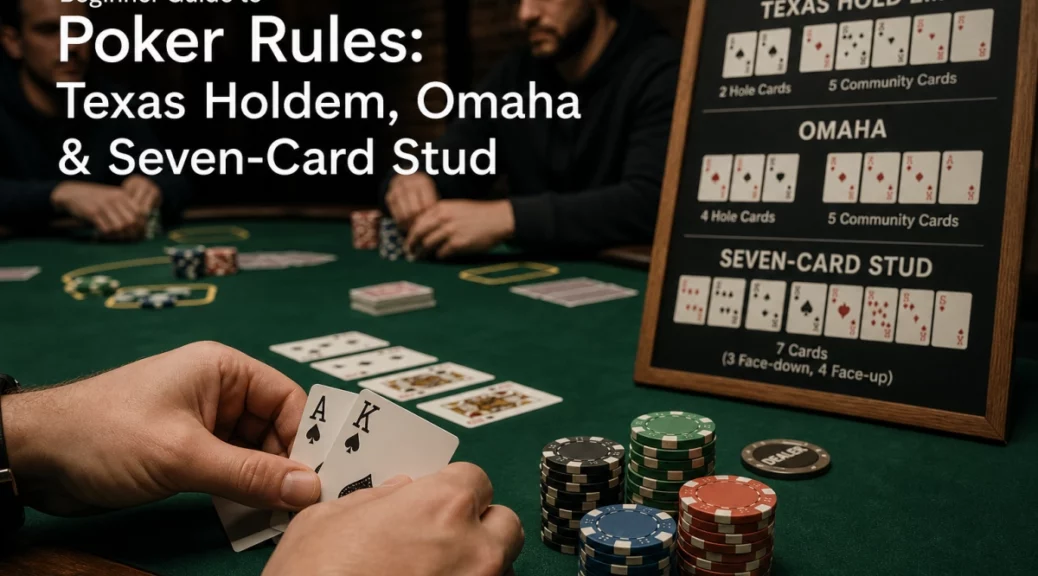
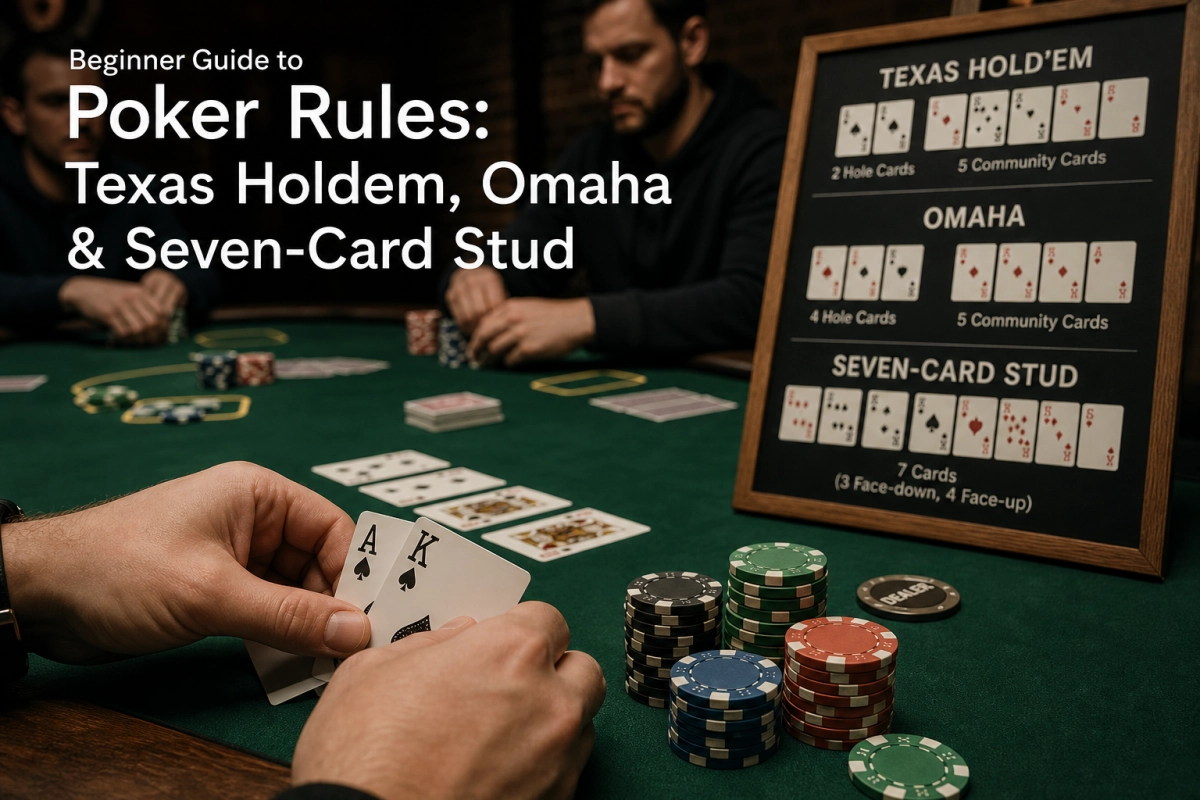
- Texas Hold’em: Each player gets two private (hole) cards; five community cards are dealt face up. Best five-card hand wins.
- Omaha: Each player gets four hole cards; exactly two of them plus three community cards make the final five-card hand.
- Seven-Card Stud: No community cards; players receive a mix of face‑up and face‑down cards over rounds and make the best five-card hand from seven.
Core rules every player should memorise
Hand rankings (strongest to weakest)
Knowing hand rankings is essential. From highest to lowest:
- Royal flush — A-K-Q-J-10 of the same suit
- Straight flush — Five consecutive cards, same suit
- Four of a kind
- Full house — Three of a kind plus a pair
- Flush — Any five cards of the same suit
- Straight — Five consecutive cards of mixed suits
- Three of a kind
- Two pair
- One pair
- High card — Highest single card when no other hand is made
When hands tie, kickers (the next-highest cards) decide the winner unless the tied hand uses all community cards in the same way.
Basic betting actions: check, call, raise, fold
These four verbs form the backbone of poker rules at the table:
- Check: Pass the action without betting when no bet is outstanding.
- Call: Match the current highest bet to stay in the hand.
- Raise: Increase the current bet. In no-limit games this can be up to a player’s entire stack; in limit games raises are fixed.
- Fold: Discard the hand and surrender any claim to the pot.
Players must act only when it’s their turn and announce or place chips clearly. In live play verbal declarations and chip placement both matter; in online play clicking the appropriate button is the standard.
Blinds, antes and the sequence of betting rounds
Blinds and antes create initial money in the pot and force action:
- Blinds: Small blind and big blind are forced bets placed by two players before cards are dealt (common in Hold’em and Omaha).
- Antes: Small contribution from every player each hand (common in later tournament stages and in Stud).
Typical betting rounds in Texas Hold’em and Omaha: pre‑flop (after hole cards), flop (three community cards), turn (fourth card), river (fifth card). Seven‑Card Stud uses alternating rounds of face‑up and face‑down cards. Betting limits vary: no‑limit, pot‑limit and fixed‑limit formats affect how much can be bet or raised.
Next, the guide will explain side pots, detailed showdown procedures, common rule mistakes to avoid at the table, and the key differences between live and online poker play.
Side pots and all‑in procedures
One of the clearest rules beginners must learn is how all‑in bets create main and side pots. When a player does not have enough chips to call a bet and goes all‑in, they can only win the portion of the pot they matched — the main pot — while any additional action creates one or more side pots that only fully staked players can contest.
Example: three players — Alice, Ben and Carla. Alice has $200, Ben has $50 and Carla has $150. Alice bets $100, Ben calls all‑in $50 and Carla calls $100. The main pot is $150 (everyone contributed $50). The side pot between Alice and Carla is $150 (the extra $50 from Alice and Carla each, plus Alice’s remaining $50 matching Carla’s $100 bet). If multiple players go all‑in for different amounts, create separate side pots in order from smallest all‑in upward.
Key practical points:
– Pots are awarded in order from the main pot outward. A player all‑in can only win the pots to which they contributed.
– Dealers or software handle the math, but at live tables always speak up politely if the pot counts seem incorrect.
– If the all‑in player is involved in a tie for a pot they can’t contest, the portion they’re eligible for is split according to standard tie rules.
– Side pots are why it’s important to understand what you’re contesting before revealing cards: you might win a main pot even if another player wins a side pot.
House rules vary slightly, so always confirm how multiple all‑ins and odd chips are handled before play.
Showdown procedures and comparing hands
Showdowns determine the winner after the final betting round. The standard order and practices keep the process fair and clear:
– Who shows first: the player who made the last aggressive action (the final bet or raise) on the river normally shows first. If the final round was checked through (no bets), the player closest to the left of the dealer/button who remains in the hand shows first. In many casinos the dealer will prompt the correct player to show.
– Exposing and mucking: reveal cards by placing them face up; if you toss your cards face down into the muck without showing them, they’re considered folded and cannot win the pot (unless a dealer or camera rule forces a show in certain edge cases). Be careful — showing only part of your hand or breaking a rule about exposing cards can lead to penalties.
– Hand comparison: the dealer (or software) compares the best five‑card hands. If hands tie, the pot is split equally; an odd chip is usually awarded to the player nearest the button (house rule dependent).
– Verifying contested pots: if two players disagree about a hand, ask the dealer or floor person. Do not argue at the table — request an official ruling.
Common rule mistakes and practical differences between live and online play
Beginners frequently make a few recurring mistakes:
– Acting out of turn: don’t bet or fold when it’s not your turn; your action may be ruled invalid.
– String bets: in live play, raise by moving chips in one motion and announcing the amount; do not start with chips in one hand and add more — that can be ruled just a call.
– Forgetting to protect cards: in live games use a card protector or keep one card cupped to avoid accidental mucking.
Live vs online differences to note:
– Online tables enforce timed actions and auto‑muck/winner determination; misclicks are common, but support rules vary — check the site’s policy.
– Live play involves physical chip handling, verbal declarations, and tipping dealers; etiquette matters. Online play has chat, auto‑seating and larger blind structures but lacks the reading of physical tells.
– Card exposure: online the software reveals all required hands at showdown; live you must physically show cards when required.
Knowing these practical differences and common pitfalls helps avoid disputes and keeps the game flowing.
Final thoughts and next steps
Learning the rules is the first step — the rest is practice, attention and courtesy. Start at low stakes, confirm any house rules before play begins, and treat other players and dealers respectfully. Over time you’ll gain confidence in handling bets, side pots and showdowns without hesitation.
Quick checklist before you sit down
- Confirm the game type, limits (no‑limit, pot‑limit, fixed), blinds/antes and rake.
- Ask how the house handles odd chips, multiple all‑ins and string bets.
- Protect your cards and manage your chips so actions are clear.
- Start small to learn betting timing and showdown procedures without big risk.
- Practice good etiquette: don’t act out of turn, avoid angle shooting, and be polite to the dealer.
- Use online play or friendly home games to build experience before moving to bigger stakes.
- Keep bankroll and time limits — poker is a skillful game, and steady improvement matters more than short‑term wins.
Play thoughtfully, keep learning from each session, and enjoy the social and strategic side of poker.