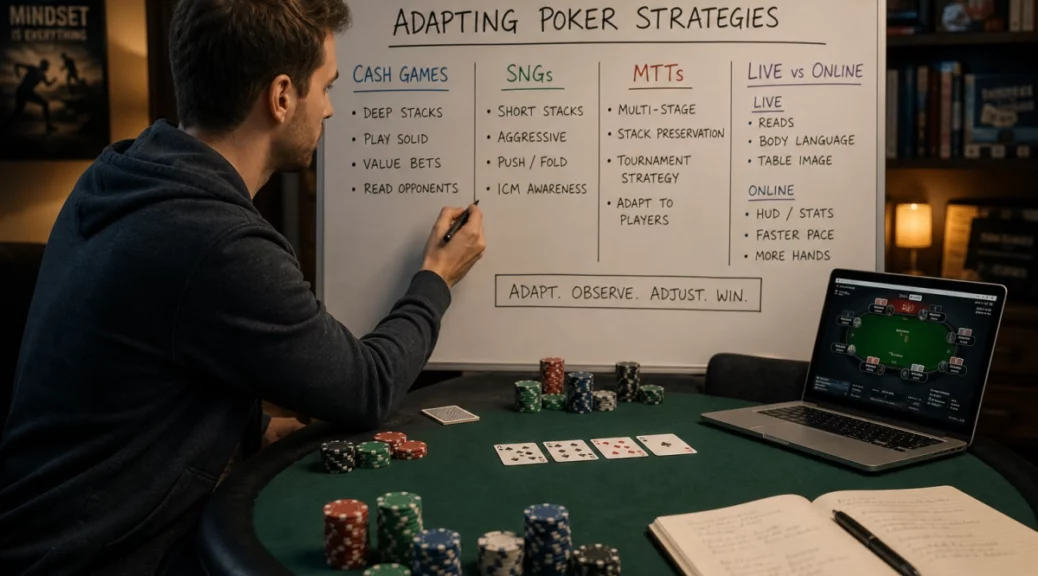
How to Adapt Poker Strategies Between Cash Games, SNGs, MTTs and Live vs Online Play
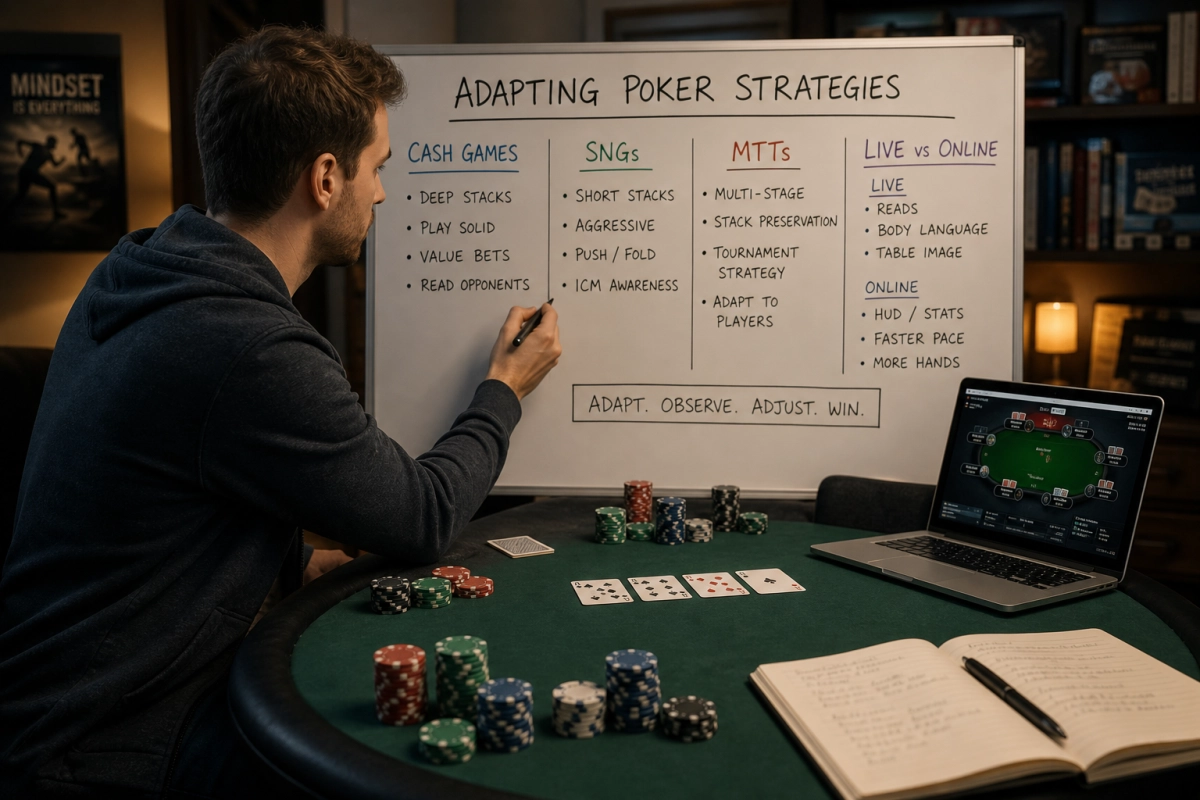
Adapting poker strategies to cash games, SNGs, MTTs and live vs online play
This guide explains key poker strategies and how to adapt them across cash games, sit‑and‑go (SNG) events and multi‑table tournaments (MTTs), and between online and live environments. Readers will learn when to tighten or widen preflop ranges, how stack depth changes postflop tactics, basic bet‑sizing rules, and practical bankroll and tilt management. Clear hand examples and common mistakes are included to help players of all levels apply these ideas responsibly.
Why formats and venue change your approach
Different formats reward different skills. Cash games use fixed blinds and allow deep stack play and more postflop maneuvering. SNGs are single-table tournaments where survival and push/fold decisions matter near the bubble. MTTs involve many players with changing payouts, increasing the importance of ICM (independent chip model) considerations. Online play is faster, multi‑tabling possible and often features looser opponents; live play is slower, tells and table image matter more.
- Cash games: Prioritise postflop skill, deeper stack play and balanced ranges.
- SNGs: Shift to push/fold models late stage; survival and bubble strategy dominate.
- MTTs: Early play resembles cash, mid/late requires adjusting for ICM and changing stack dynamics.
- Online vs live: Online allows larger sample sizes and HUD reads; live rewards observation, bet timing and table selection.
Practical preflop range adjustments
Preflop ranges are the starting point for good poker strategies. They should change by format, stack depth and opponent tendencies.
Broad rules for opening ranges
- Deep‑stack cash (100+ big blinds): Open wider from late position; include suited connectors and small pairs for set‑mining.
- Shorter stacks (20–40bb), common in SNGs/MTT mid‑late stages: Tighten opening ranges; prioritise hands that play well all‑in or fold equity (high card strength, broadway, medium pairs).
- Online vs live: Online opponents often call wider — tighten marginal speculative hands live when players are more calling‑oriented.
Example hand: adapting the same spot
Situation: UTG opens to 3bb. Hero in CO with AJs.
- Cash game (100bb effective): Cold‑call or 3‑bet to 9–12bb for value and fold equity; AJs plays well postflop.
- SNG near bubble (25bb effective): 3‑bet shove or fold depending on opponent stack and ICM — avoiding marginal flat calls that risk tournament life.
- Live home game with passive table: Call more frequently to extract value postflop; online turbo SNG: lean toward shoving wider preflop.
Early bankroll and tilt management for all formats
Responsible bankroll management is part of sound poker strategies. Set stakes where variance is affordable and avoid rapid promotions in stakes after short winning runs.
- Bankroll rules: For cash games, use at least 20–40 buy‑ins for the stake; for SNGs and MTTs, use more (50–100 buy‑ins) due to higher variance.
- Tilt control: Recognise tilt triggers (bad beat, ego, fatigue). Use timeouts, lower stakes or a planned break to reset. Avoid chasing losses — that increases tilt and destroys long‑term results.
- Common mistake: Switching formats or stakes mid‑session after a big loss or win. Stick to a plan and session limit.
Next, the guide will break down postflop tactics, bet sizing and stack‑depth effects with specific hands that illustrate common mistakes and corrective adjustments.
Postflop tactics: converting ranges into profitable lines
Postflop play is where formats diverge most. The same hand requires very different mindsets depending on stack depth, tournament stage and opponent tendencies. Focus on three fundamentals: range construction, exploitation vs balance, and pot control based on stack‑to‑pot ratio (SPR).
- Range construction: In deep‑stack cash, plan lines for a wide range — value hands, bluffs and semibluffs. In SNGs/MTTs with shallower stacks, your range narrows toward hands that can get all‑in or fold efficiently.
- Exploitative vs balanced: Newer or looser opponents should be exploited (more value bets, fewer bluffs). Versus competent players you must mix lines — occasional check‑raises and river bluffs to avoid being transparent.
- SPR and pot control: Low SPR (≤3) favors commit/all‑in decisions with top pairs and decent kickers; high SPR (>6) rewards postflop maneuvering and speculative hands that can win big pots via straights/flushes.
Example 1 — cash game (100bb): Hero opens CO, BB calls. Flop A♠ 8♦ 4♣ (pot 7bb).
- Play: C‑bet ~2.5–3bb (≈35–45%). On dry boards you want a small c‑bet to fold out overcard hands while preserving multi‑street options with strong hands. If BB is a sticky caller, size up to ~50% to charge draws.
- Why: With deep stacks you can keep a balanced range: some bluffs (A‑low blockers, backdoor draws) and thin value (top pair). Overforcing with large bets on every street reduces your flexibility and opens you to float‑and‑bluff lines.
Common postflop mistakes:
- Over‑bluffing in tournaments near bubble — risking tournament life for marginal fold equity.
- Never adjusting c‑bet frequency to opponent type (small vs passive callers online; larger bets vs calling stations).
- Failing to plan the entire line — bet sizes should set up subsequent actions (e.g., a small flop bet that commits you to a large turn with marginal hands).
Bet sizing and stack‑depth effects: rules of thumb and hands that illustrate them
Bet sizing communicates strength and sets the economics of the hand. Adjust sizes by format, live/online venue, and your objective (fold equity, value extraction, protection).
- Preflop sizing: Online open 2.5–3bb; live open 3–4bb due to fewer multi‑tablers and higher call frequencies. Versus limpers add 1bb per caller.
- Flop sizing: Dry boards: 25–45% pot to leverage fold equity. Wet boards: 50–75% to charge draws and get value from strong hands.
- Turn/river sizing: Use polarised large sizes when you have a clear value or bluff; use smaller thin value bets to get called by worse hands.
- Stack‑depth rules: With
Example 2 — SNG late stage (25bb): Hero in CO with KQo; button opens to 2.5bb, blinds call (3‑way). Pot ≈8.5bb.
- Play: Folding or a shove depends on reads. With passive callers, a shove from CO becomes +EV because callers are wide and you fold better hands. Against tight stacks, a shove risks being called by better hands. Generally, at ~25bb avoid small flop probes — commit or fold preflop.
- Why: Lower stack depth makes postflop play binary; bet sizing choices before the flop determine whether postflop decisions are meaningful.
Common sizing mistakes:
- Using the same default sizes across all formats — an online 2.5bb open isn’t equivalent to a live 3.5bb open in its postflop implications.
- Underbetting for thin value on river — small rivers often fold out worse hands; pick sizes that get value without turning opponents onto bluffs.
- Ignoring SPR — bloating the pot with marginal hands in low‑SPR spots commits you unnecessarily.
Putting strategy into practice
Theory only improves your win rate when you turn it into repeatable habits at the table. Use the short checklist below to convert the concepts you’ve learned into session routines and decision processes you can rely on across cash games, SNGs, MTTs and both live and online play.
Session checklist
- Choose one focus per session (e.g., preflop ranges, bet sizing on wet boards, ICM decisions) and review only that area afterward.
- Set bankroll and session limits before you start — know your max downside and stop when you hit it.
- Note stack depths and expected SPR ranges for common spots you face; mark hands where SPR forced a change in plan.
- Adjust opening and c‑bet sizes to the venue: slightly larger preflop opens live, slightly smaller flops online; tune versus opponent tendencies.
- Log hands that felt unclear and review them later with software or a study partner; look for repeated mistakes rather than isolated bad beats.
- Schedule short breaks to manage fatigue and tilt; if tilt appears, step away and reset rather than forcing recovery in play.
Short illustrative routine
- Before the session: pick stakes and format, set buy‑in size, set a target focus (e.g., “avoid marginal calls with
- During the session: apply the only‑one‑focus rule, write 1–2 hand notes per hour, use practical sizing rules (2.5–3bb online, 3–4bb live preflop).
- After the session: review key hands, update your preflop and postflop cheat sheets, log any tilt triggers and corrective actions.
Final thoughts and next steps
Improvement in poker is incremental. Prioritise consistent practice, disciplined bankroll management and honest review of your hands. Focus on one adjustment at a time, track its impact, and be patient with results. Over time, blending format‑specific tactics with a clear, repeatable routine will make adapting between cash, SNGs, MTTs and live versus online play a natural part of your game.
Tools, study and practice drills
Improving quickly requires deliberate study and the right tools. Use hand‑history review software and equity calculators to check lines and frequencies, and solvers to explore balanced strategies for common spots. Combine solver work with exploitative adjustments — using GTO as a baseline then shifting toward higher EV plays against identified weaknesses. Keep study sessions short and focused: quality beats quantity when you target a single leak or concept each sitting.
Recommended tools and how to use them
- Hand history trackers (Hold’em Manager, PokerTracker): build a sample, tag recurring spots, and identify which opponents you should adjust to.
- Equity calculators (Equilab, Flopzilla): practice range vs range equity and understand how frequently you should continue with draws or pairs.
- Solvers (PioSolver, GTO+): study specific river/turn decisions and default bet‑size mixes, then simplify those outputs into practical rules you can remember at the table.
- ICM tools (ICMIZER): essential for SNG/MTT bubble and final table decisions to quantify fold/call thresholds.
Mini practice drills
- Preflop drill (30 minutes): pick one position and play only the recommended opening and 3‑bet ranges; review hands you deviated from.
- C‑bet drill (45 minutes): focus on flop sizing choices across wet and dry boards; log outcomes and opponent reactions.
- ICM push/fold drill (20 minutes): practice using charts or an ICM app to internalise shove/fold thresholds at common stack depths.
- Solver translation (60 minutes): study one solver spot and create a short, simplified cheat sheet of 3–4 actionable lines for that location.
Live tells and online timing — reading the table
Reading opponents differs by venue. Live reads come from body language, breathing, chip handling and bet timing; online reads rely on timing, bet sizing patterns and HUD statistics. While tells can be helpful, prioritise tendencies (how often someone calls 3‑bets, c‑bets, or check‑raises) over flimsy signals. Use live tells as supplementary information, not the primary decision driver, and corroborate any read with betting patterns before making high‑variance plays.
- Live: note physical confidence indicators, relaxation or sudden posture changes, and consistent timing habits tied to strong or weak hands.
- Online: track timing (snap calls vs tanking), size patterns, and use HUD popups to confirm frequency‑based reads.
- General rule: when a read conflicts with statistical tendencies, trust the stats unless you have long‑term behavioral evidence.
Incorporate these tools, drills and read frameworks into your session checklist. Structured practice plus disciplined in‑game application shortens the gap between theory and profitable play across cash games, SNGs, MTTs and both live and online formats.