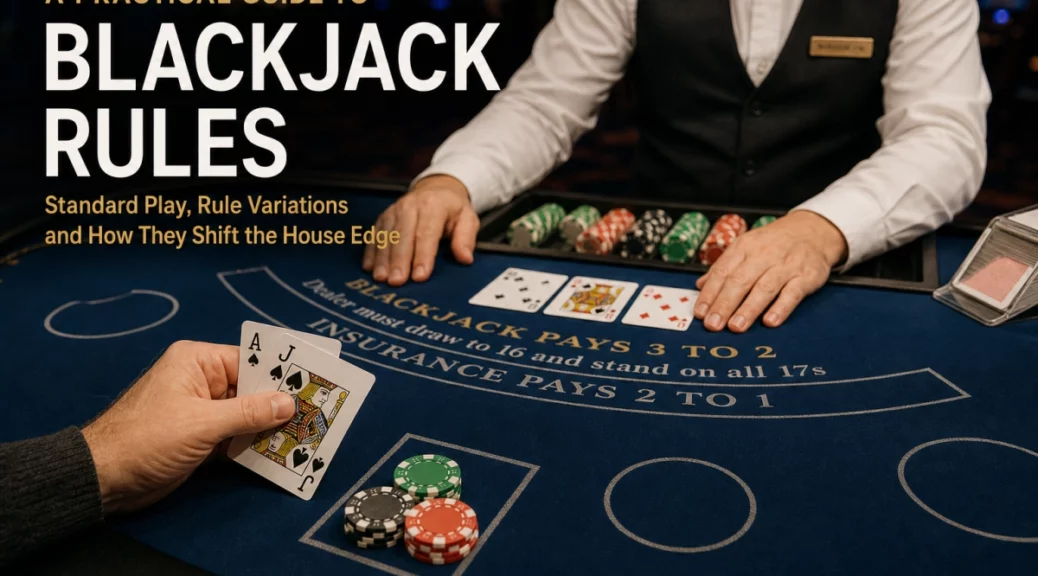
A Practical Guide to Blackjack Rules: Standard Play, Rule Variations and How They Shift the House Edge
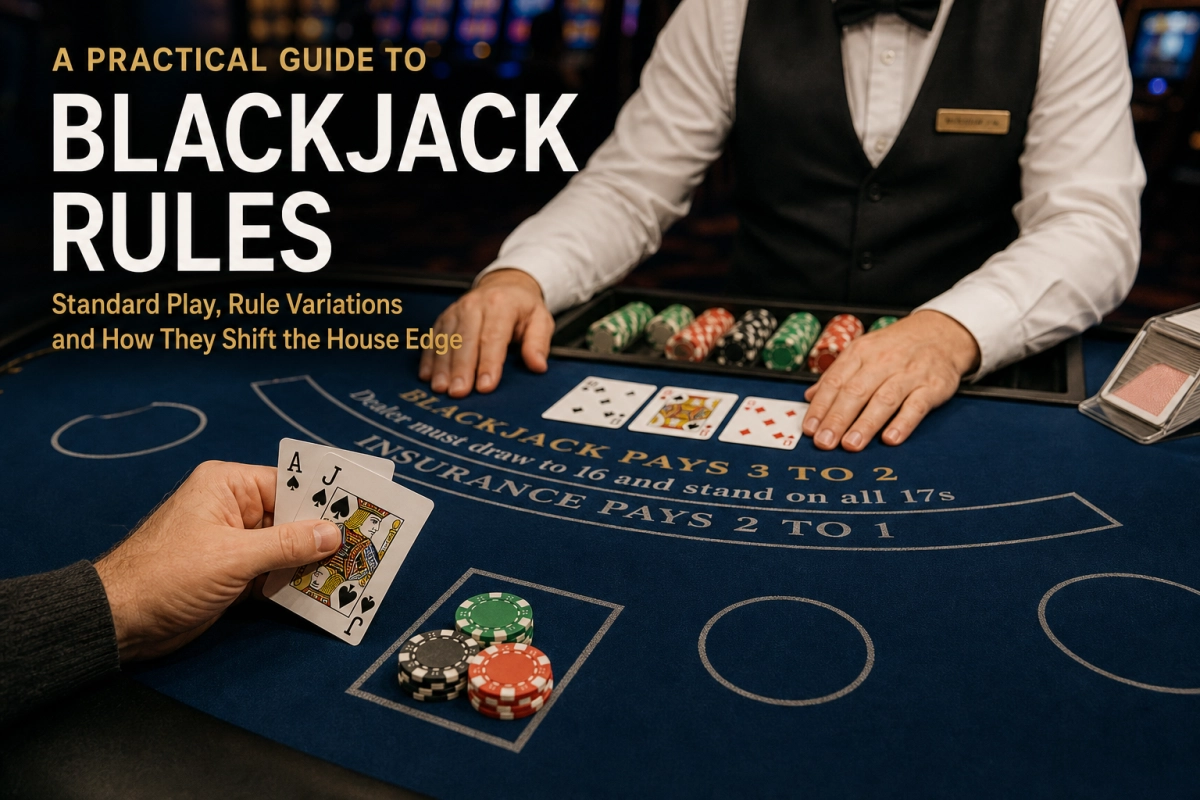
How blackjack rules shape your edge and the table choices a player should make
Blackjack rules determine the small differences between a playable game and one where the house has a much bigger advantage. This guide explains the core blackjack rules, the most common variations (number of decks, dealer hits/stands on soft 17, doubling and splitting restrictions, surrender options, blackjack payouts, and the dealer peek), and quantifies how each change affects house edge. Readers will get clear examples and practical strategy nudges so they can choose better tables in both land-based and online casinos.
Basic table rules every player should know
At a standard blackjack table the aim is to beat the dealer without busting. Key elements of standard rules include:
- Player and dealer are each dealt two cards; player cards are usually face up and dealer one up/one down.
- Card values: 2–10 as face value, J/Q/K = 10, Ace = 1 or 11 (soft vs hard totals).
- Player options: hit, stand, double down (double bet for one extra card), split (separate identical cards into two hands) and sometimes surrender (forfeit half bet).
- Blackjack (Ace + 10-value on first two cards) usually pays 3:2 under good rules; inferior tables may pay 6:5 or worse.
- Dealer play is fixed by rule: either stands on soft 17 (S17) or hits soft 17 (H17).
Using basic strategy (a mathematically derived decision chart) lets a player minimize the house edge. With common favorable rules (6 decks, S17, double after split allowed, surrender available) the house edge with perfect basic strategy typically sits below 0.5%. Small rule changes move that number up or down—next sections explain how.
Common rule variations and approximate effect on house edge
Below are the rule changes players encounter most often and a practical estimate of how they shift the house edge. Numbers are approximate — actual impact depends on the full rule set combined with number of decks.
Number of decks
More decks generally increase house edge because they slightly reduce player blackjack frequency and alter card composition. Moving from single-deck to six-deck typically increases the house edge by roughly 0.2–0.4 percentage points. For example, a single-deck S17/DAS game might offer a house edge near 0.2% for perfect basic strategy, while a six-deck equivalent could be ~0.4–0.5%.
Dealer hits or stands on soft 17 (H17 vs S17)
If the dealer hits soft 17 (H17) the house edge increases by about 0.1–0.2%. Practically, when facing H17 the player should be slightly more conservative with soft hands (e.g., be less likely to stand on soft 18 against dealer 3–6) and favor doubling opportunities when available.
Doubling rules (double after split, doubling restrictions)
Allowing double after split (DAS) reduces house edge by roughly 0.08–0.15% versus forbidding it. Restricting doubles to only 9–11 can add ~0.15–0.25% to the house edge. Strategy adjustment: when DAS is allowed, players can confidently split and then double more aggressively; when doubling is restricted, avoid marginal doubles and follow a tighter basic strategy.
Next, the guide will break down splitting specifics, surrender options, blackjack payout differences (3:2 vs 6:5) and the dealer peek, with concrete examples and a simple table comparing expected house edge for typical rule combinations.
Splitting rules: resplits, splitting aces, and practical strategy shifts
Splitting options vary more than most players expect. Common rule points are whether you can resplit pairs (often up to 3–4 hands), whether aces can be resplit, and whether split aces receive only one card (and cannot be hit). These specifics matter: allowing resplits and allowing hits after splitting aces reduce the house edge, while restrictions increase it.
Approximate impact: allowing resplits to 4 hands typically lowers house edge by ~0.05–0.12%; allowing resplit of aces gives another ~0.05–0.08% benefit; forcing only one card on split aces (and no hits) increases house edge by ~0.10–0.20% compared with allowing hits. The exact numbers vary with deck count and other rules, but the direction is consistent.
Practical examples and strategy nudges:
– Always split Aces and 8s regardless of most rules. If resplitting aces is allowed and you receive a second ace after splitting, resplit — the expected return improves.
– Never split 10s or 5s; ten-value pairs are strong hands, and splitting them is a losing play long-term.
– Split 2s and 3s versus dealer 2–7 when doubling after split (DAS) is allowed; if DAS is forbidden or resplits are not allowed, be more conservative (e.g., only split 2s/3s vs 4–7).
– If split aces get only one card, treat those hands as weaker — avoid extra aggressiveness around re-splitting and don’t expect to build big hands off split aces.
Surrender options: early vs late and when to fold
Surrender lets you forfeit part of your bet rather than play a weak hand. Two types exist: early surrender (before dealer checks) and late surrender (after dealer checks for blackjack). Early surrender is rare but powerful; late surrender is common and still useful.
Approximate impact: late surrender typically reduces house edge by about 0.07–0.20% depending on decks and other rules; early surrender is much stronger and can reduce edge by roughly 0.50–0.65% (a significant swing). Because the benefit is contextual, casinos often limit surrender or offer only late surrender.
Simple surrender strategy:
– With late surrender available, surrender hard 16 (but not a pair of 8s) against dealer 9, 10 or Ace in most games. Surrender hard 15 against dealer 10 in many rule sets.
– If only early surrender exists (rare), follow the same surrender situations but be even more inclined to use the option when offered.
– If surrender is not available, avoid plays that mimic surrender (e.g., splitting to salvage value) unless mathematically justified.
Blackjack payouts and the dealer peek: the rules that move the needle most
Blackjack payout and dealer peek rules are among the single biggest determinants of expected return. A 3:2 payout for a natural is standard; 6:5 (or worse) is a large player penalty. The dealer peek (checking their downcard for blackjack when showing Ace or 10) prevents players from making extra bets that get lost to a dealer blackjack.
Quantified effects:
– Changing blackjack payout from 3:2 to 6:5 adds roughly 1.4–1.5 percentage points to the house edge — a drastic increase that overwhelms most favorable tweaks elsewhere. Always avoid 6:5 tables unless there’s some other compensating rule (rare).
– Removing the dealer peek increases house edge by about 0.10–0.20% because players can lose extra money from doubled/split hands that would have been pushed or avoided when the dealer checks.
Practical table selection: prioritize 3:2 games, S17 over H17 where possible, DAS and reasonable resplits, and some form of surrender. Favor tables with dealer peek and avoid any 6:5 payouts — that single change typically turns a playable game into a poor bet. Online, check the rules box carefully (payout, peek, DAS/resplits) before sitting down; in live casinos ask the dealer or floor when in doubt.
Practical rule-combination examples (approximate house edge and one-line strategy nudge)
- Single-deck, S17, DAS, resplit aces, 3:2 payout — house edge ≈ 0.2%: play basic strategy for single-deck and be aggressive with doubles and resplits.
- Two-deck, S17, DAS, late surrender, 3:2 payout — house edge ≈ 0.25–0.35%: use surrender on H15 vs dealer 10 and H16 vs 9–A where appropriate.
- Six-deck, S17, DAS, late surrender, 3:2 payout — house edge ≈ 0.4–0.5%: follow six-deck basic strategy; maintain standard doubles and splits, use late surrender spots.
- Six-deck, H17, no DAS, no resplits, 3:2 payout — house edge ≈ 0.7–0.9%: be more conservative with soft hands and avoid marginal doubles/splits.
- Six-deck, H17, no DAS, no resplits, 6:5 payout — house edge ≈ 2.1–2.4% (or worse): avoid this table unless you have a nonstandard compensating advantage.
Quick strategy adjustments at a glance
- Facing H17 tables: stand a little less often on soft totals; look for more double opportunities on hard 9–11 against dealer weak upcards.
- No double after split (no DAS): reduce splitting of small pairs (2s, 3s) versus dealer 2–7; avoid aggressive split-and-double lines.
- Resplits restricted or split-aces receive one card: treat split-ace hands as weaker — don’t plan on building large hands from them.
- Late surrender available: surrender hard 16 vs 9–A and hard 15 vs 10 where recommended by your basic-strategy chart; if unsure, consult the chart before acting.
- 6:5 payout spotted: leave the table. Strategy adjustments cannot compensate for the large payout penalty on naturals.
- No dealer peek: avoid doubling or splitting extra bets when dealer shows Ace or 10 and the casino does not check for blackjack first.
Putting the guide into practice
Treat rule knowledge and small strategy tweaks as tools that protect your bankroll and extend play — not guarantees of winning. Before you sit, check the rules board or ask the dealer, pick the best rule set you can reasonably find, and commit to a basic-strategy chart tailored to the deck-count and rule variations at that table. Practice decisions in low-stakes online play or simulator apps until the adjustments feel automatic. Manage your session stakes, avoid emotionally driven deviations, and remember that small rule differences compound over time: choosing the right table is often the single most effective edge you can get short of card counting. Play smart, play disciplined, and let the math guide the choices you make at every shoe.