
A hands-on guide to poker strategies: format-specific tactics for preflop ranges, position, sizing and ICM
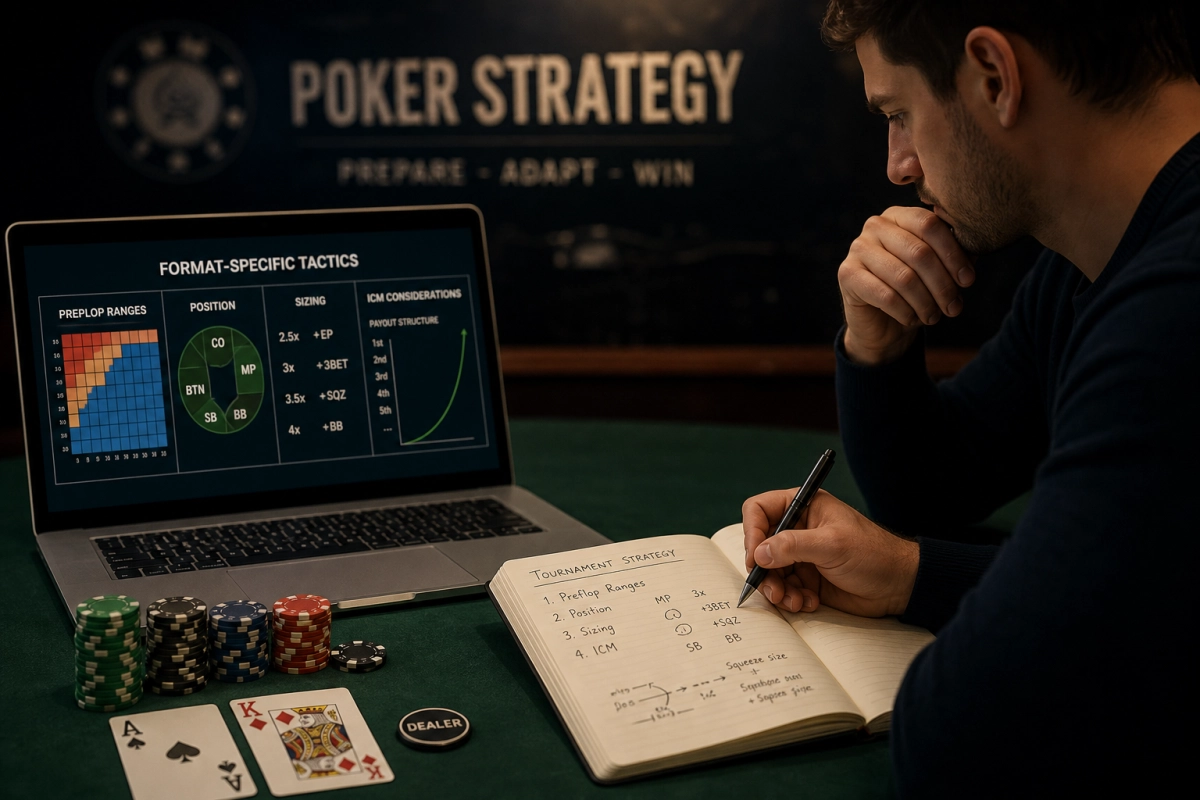
A hands-on guide to poker strategies that teaches format-specific tactics
This guide to poker strategies explains, in plain language, how to adjust preflop ranges, use position, choose bet sizes, set bluffing frequency and handle ICM (Independent Chip Model) and stack-depth changes. Readers will learn practical, format-specific tactics with examples for common stakes and typical player types. Poker involves chance — no strategy guarantees wins — so treat the advice as ways to reduce mistakes and improve long-term decisions.
Practical preflop ranges by seat and player type
Preflop ranges describe which hands a player should open, call or 3‑bet with from each seat. A range is a percent of possible hands (for example, 15% of starting hands) rather than a single hand. Adjust ranges by table stakes and opponent tendencies.
Simple opening ranges (cash games, full-ring)
- Under the Gun (UTG, tight): ~12–15% — strong broadways, most pairs (AJs+, TT+), suited connectors rarely.
- Middle Position (MP): ~15–20% — add more Broadway combos, more suited aces and medium pairs.
- Cutoff (CO): ~22–28% — wider: suited connectors, more Ax, mid pairs, some bluffs.
- Button (BTN, late, aggressive): ~35–50% — very wide open range to exploit position.
- Small Blind (SB): defense depends on blind v blind and stack — defend tighter vs strong openers.
Example adjustments for player types:
- Facing tight players: widen stealing range on CO/BTN and 3‑bet more as a bluff.
- Facing loose-aggressive players: tighten calling range, value 3‑bet more with strong hands.
- Microstakes players: value-bet more often; they call light — reduce fancy bluffing.
Using position and early bet sizing to gain an edge
Position is the single most important skill edge in poker. Acting after opponents provides crucial information — so widen ranges and use smaller, more frequent bets when last to act.
Positional tactics and examples
- Late position (BTN/CO): open-raise more often, increase continuation bet (c-bet) frequency on dry boards.
- Early position (UTG/MP): play more straightforwardly — tighter opens and fewer bluffs postflop.
- Blind play: defend the blinds with hands that play well postflop (suited connectors, suited aces) and avoid bloated multiway pots with weak offsuit hands.
Bet sizing rules of thumb
- Cash-game preflop opens: 2–3× big blind (smaller in deep-stacked or live lower-stakes games).
- 3‑bets: 2.5–3× the open raise (adjust vs very loose/very tight callers).
- Flop c-bets: 40–70% of pot — smaller (40–50%) on wet/connected boards to control pot and extract value; larger (60–70%) on dry boards to fold equity.
- Value-bets vs calling stations: size up to extract, but avoid overcommitting without strong hand equity.
Short-stack vs deep-stack: with short stacks (≤40 big blinds) favor push/fold or simple value strategies; with deep stacks (100+ bbs) play more speculative hands and use smaller, frequent bets to manipulate ranges.
Next, the guide will dig into postflop tactics: c-bet planning, calculating optimal bluff frequency, and tournament-specific ICM adjustments with clear examples for common stakes and player types.
Postflop c-bet planning by board texture and opponent type
Continuation bets (c-bets) are not automatic — they should be a planned tool based on board texture, stack sizes and who you’re up against. Think in three buckets:
- Dry boards (rainbow, disconnected, e.g., K♦7♣2♠): high fold equity. Use a higher c-bet frequency (60–80%) and sizing near 60–70% of the pot to maximize folds from single-pair or air hands.
- Semi-wet boards (one draw, one overcard, e.g., A♠9♠6♦): moderate fold equity. Use medium frequency (40–60%) and 40–50% pot sizing; prefer to c-bet with hands that have some showdown value or backdoor equity.
- Wet/connected boards (two-tone, coordinated, e.g., 9♣8♠7♠): low immediate fold equity. C-bet rarely as a pure bluff (20–35%) and favor check/call or delayed c-bets with strong hands or hands that can bluff on later streets.
Adjust for opponent type:
- Calling stations (microstakes regs): c-bet less as bluffs, increase value-bet sizing and frequency — aim to get called when you have the goods.
- TAG (tight‑aggressive) opponents: exploit their tendency to fold marginal holdings by c-betting more on dry boards and using bigger sizes when representing strong hands.
- Loose-aggressive opponents: c-bet selectively with real equity; be ready to check‑raise or check/fold depending on stack depth.
Example: CO opens, BTN calls. Flop K♥6♦2♣. Against a TAG on the BTN, a 65% pot c-bet is appropriate with Kx, A‑K bluffs and even some ace‑high turns. Against a microstakes caller, c-bet smaller (45%) with Kx and avoid bluffing with A‑Q unless you can barrel later.
Bluffing frequency and sizing — simple math to stay unexploitable
Use pot odds to choose bluff frequency. If you bet a fraction f of the pot, the opponent must call f/(1+f) of the time to break even. To keep your bluffs balanced, the ratio of bluffs to value bets on that line should be roughly f (bluffs:value ≈ f:1).
- 50% pot bet (f=0.5): opponent needs to call 0.5/1.5 ≈ 33% — set bluff:value ≈ 0.5 (one bluff per two value bets).
- 33% pot bet (f≈0.33): opponent needs to call ≈ 25% — bluff:value ≈ 0.33 (one bluff per three value bets).
- 75%+ pot bet: opponent needs to call ≈ 43–50% — you can bluff more often relative to value hands.
Practical rules:
- On wet boards, reduce pure bluffs; instead use blockers (A‑x with an ace blocker) and double‑barrel only when turn improves your story.
- Against weak reg/calling stations, lower bluff frequency and focus on thin value bets — they call too light for bluffs to be profitable often.
- Balance is a long-term goal; at micro/low stakes, exploit player tendencies more than GTO balance.
ICM and stack-depth adjustments for tournaments and SNGs
Tournament decisions must account for payout structure. ICM makes marginal calls and pushes more costly near bubbles or pay-jumps.
- Bubble/final table in MTTs: tighten calling ranges vs shoves, widen shove ranges for short stacks because fold equity is premium. For example, with 15–25 big blinds and a medium stack, open-shove steals should be tighter when bubble pressure is high; conversely, a short-stack (≤10 bbs) should shove wider from late position.
- SNG heads-up/top-heavy payouts: be risk-averse when calling all‑in with marginal equity; preserve fold equity. Use shove/fold charts: typical push ranges at 10 bbs in late position include broadway and most suited connectors down to 76s; vs tight callers, push even lighter.
- Stack-depth transitions: 40–100 bbs — play more speculative hands for implied odds (small pockets, suited connectors). 20–40 bbs — avoid complicated postflop lines, favor straightforward open-shoves or smaller raises. ≤20 bbs — use push/fold + straightforward value shoves.
Example: In a 100‑entry MTT on the bubble, you (30 bbs) face a CO open from a tight player (20 bbs) who folds to aggression. Rather than calling a 2.5× raise with K9s, consider a 3.5× re‑raise shove or folding — stealing equity and avoiding a marginal postflop decision under ICM pressure.
How to practice and improve — drills and a simple study plan
Daily and weekly drills
- Warm-up (10–15 minutes): review a short set of hands you played previously to spot leaks and obvious tilt triggers.
- Focused play session (45–90 minutes): pick one objective (e.g., BTN steal frequency, 3‑bet defense, c‑bet sizing) and track how often you follow your plan.
- Solver/analysis time (30–60 minutes, 2–3× week): run a few tricky spots through a solver or equity calculator to understand balance and exploitative deviations.
- ICM practice (weekly): run through common bubble and final‑table spots with push/fold charts or simulators until ranges feel intuitive.
- Hand-history review (weekly): tag hands by mistake type (bet sizing, fold/call error, range misread) and make one concrete adjustment to work on next session.
Metrics and tools to track progress
- Basic HUD metrics: VPIP, PFR, 3‑bet, fold‑to‑c‑bet, WTSD — use these to identify where your decisions deviate from target ranges.
- Session goals: set one or two measurable goals per session (e.g., open 30% from BTN, limit bluff frequency on wet boards to X%).
- Bankroll and tilt control: track ROI and session variance separately; stop when you detect tilt or when a session goal is missed repeatedly.
- Peer review: discuss hands with a study partner or small group to get alternate perspectives and accountability.
A final note on developing your game
Improvement comes from consistent, focused practice and the humility to adjust when the results — not just your instincts — show a pattern. Treat each session as data: set a few clear objectives, review the outcomes, and make small, measurable changes.
Balance studying theory (equity, ICM, solver insights) with exploitative practice tailored to your usual stakes and opponents. Over time, aim to make fewer avoidable mistakes and to recognize the spots where deviation from “balanced” play is profitable.
Stay patient. Poker is a long‑term pursuit where discipline, emotional control and deliberate practice compound into real gains. Commit to the process, and let steady improvements in decision quality drive your results.