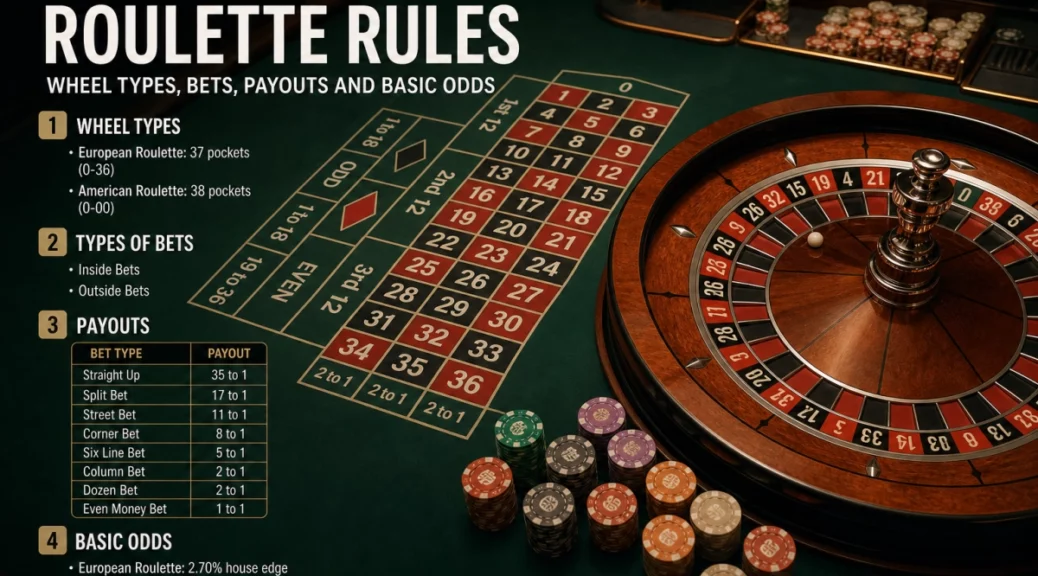
A step-by-step guide to roulette rules: wheel types, bets, payouts and basic odds
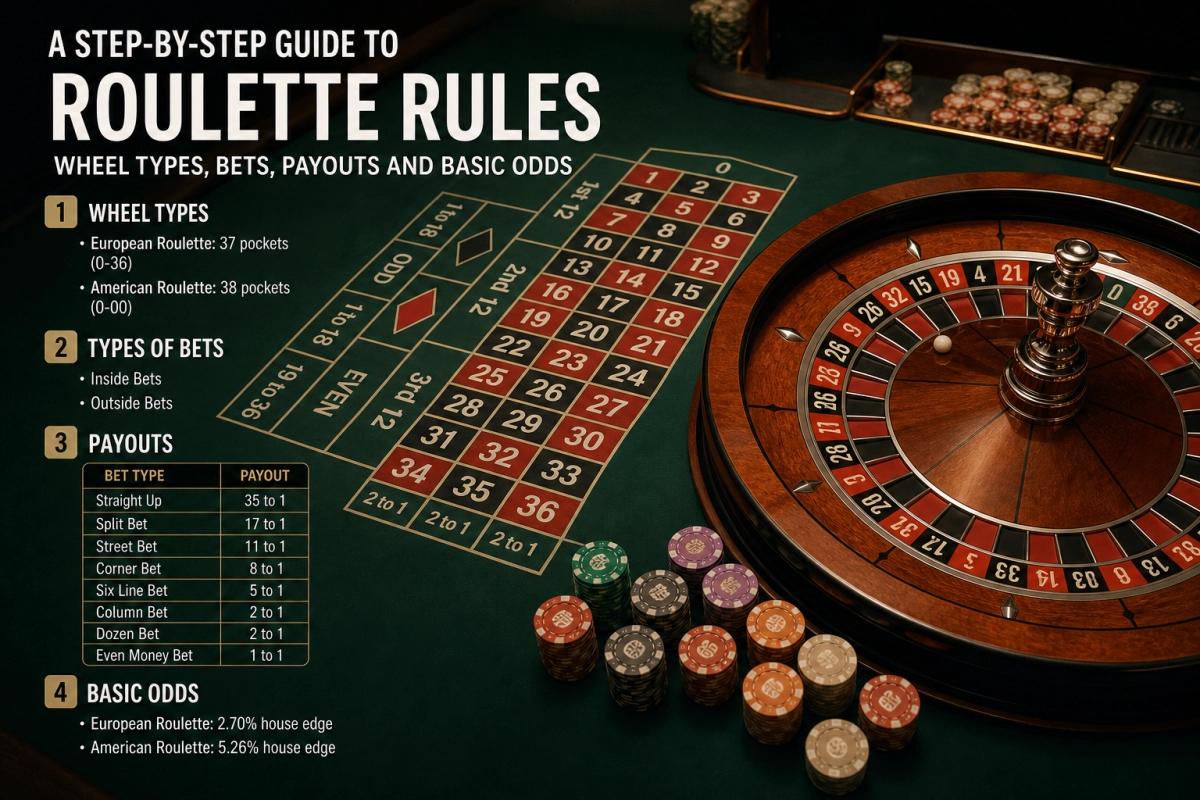
Learn the essential roulette rules: wheel types and betting basics
This guide to roulette rules explains how different roulette wheels work (European, American, French), the common bets and their payouts, and the basic probabilities players should know. Readers will get a clear, step‑by‑step introduction to bet categories, simple odds and how house edge and RTP vary by wheel type — presented in plain language for beginners and useful as a refresher for experienced players.
How roulette wheels differ and what that means for odds
Roulette wheels vary by the number and type of pockets. Differences are small visually but important for probability and house edge — two key concepts in roulette rules. The “house edge” is the casino’s mathematical advantage; “RTP” (return to player) is the theoretical percentage returned to players over the long run (RTP = 100% − house edge).
| Wheel type | Pockets | Typical house edge | Typical RTP |
|---|---|---|---|
| European | 37 (0–36) | 2.70% | 97.30% |
| American | 38 (0, 00, 1–36) | 5.26% | 94.74% |
| French | 37 (0–36) | 2.70% (or 1.35% on even bets with La Partage) | 97.30% (or 98.65% for even bets with La Partage) |
Note: French roulette often uses the La Partage or En Prison rule for even‑money bets, which lowers the effective house edge on those bets. Always check the table rules before playing.
Common bet types, payouts and simple odds
Roulette bets divide into inside bets (specific numbers or small groups) and outside bets (larger groups, even/odd, red/black). Payouts are fixed and the same on most wheels; probability changes with the wheel size.
Inside bets (higher payouts)
- Straight (single number): payout 35:1. Probability (European): 1/37 ≈ 2.70%.
- Split (2 numbers): payout 17:1. Probability: 2/37 ≈ 5.41%.
- Street (3 numbers): payout 11:1. Probability: 3/37 ≈ 8.11%.
- Corner (4 numbers): payout 8:1. Probability: 4/37 ≈ 10.81%.
- Six‑line (6 numbers): payout 5:1. Probability: 6/37 ≈ 16.22%.
Outside bets (lower payouts, higher chance)
- Dozen or Column (12 numbers): payout 2:1. Probability: 12/37 ≈ 32.43%.
- Even/Odd, Red/Black, High/Low (18 numbers): payout 1:1. Probability: 18/37 ≈ 48.65% (European).
On American wheels, replace 37 with 38 when calculating probabilities (e.g., straight = 1/38 ≈ 2.63%). Payouts remain the same, which is why the house edge is higher on American roulette.
Players should remember that payouts are quoted as “x:1” (profit) and that the presence of zero (and double zero) is what gives the casino its edge. Next, the guide will break down probability and RTP tables in detail, compare house‑edge scenarios side‑by‑side, and explain how live dealer and online roulette differ in practice.
Probability and RTP — side‑by‑side comparisons and simple expected value
All roulette bets share the same mathematical framework: each spin is independent, and the payout schedule does not change to reflect the true probability of hitting a bet. That discrepancy is what creates the house edge and determines RTP (return to player).
Here are compact comparisons you can use when choosing a table or bet type:
- European wheel (single zero): house edge 2.70% → RTP ≈ 97.30%. Expected loss ≈ $2.70 per $100 wagered over the long run.
- American wheel (double zero): house edge 5.26% → RTP ≈ 94.74%. Expected loss ≈ $5.26 per $100 wagered.
- French wheel with La Partage (even‑money bets only): effective house edge 1.35% → RTP ≈ 98.65% on those bets (other bets stay at 2.70% unless the rules specify otherwise).
Example of expected value for a single spin: on a European wheel a straight (single number) bet has probability 1/37 ≈ 2.70% and pays 35:1. The mathematical expected return per unit bet is (35 × 1/37) + (0 × 36/37) = 35/37 ≈ 0.9459, or 94.59% — which matches the overall house edge once you include the casino keeping the losing stake. Expected loss per $1 bet ≈ $0.027.
Keep these points in mind when reading RTP or probability tables: RTP is a long‑run theoretical average; short sessions can vary widely. Also check table rules (La Partage/En Prison) because they materially affect expected value on even‑money bets.
Live dealer vs online (RNG) roulette: what changes for the player
Functionally, roulette rules and payouts stay the same whether you play on a physical live wheel or an online simulated wheel. The differences are in speed, transparency, social factors and sometimes bet options:
- Transparency: live dealer roulette uses a physical wheel you can watch via video stream; RNG (random number generator) games simulate spins algorithmically. Reputable online casinos publish RNG audit certifications and payout reports.
- Pace and limits: online RNG games are faster and often allow lower minimum bets; live tables tend to be slower, with human dealers and larger minimums in casino or live‑studio setups.
- Variants and side bets: online platforms commonly offer many variants (mini roulette, multi‑wheel, special side bets). Live tables usually stick to standard formats but can include VIP or themed streams.
- Interaction and etiquette: live dealer tables provide a social experience and dealer interaction; RNG games are solitary and generally offer autoplay features for convenience.
- Fairness and practical differences: both formats can be fair when operated by licensed providers. Check licensing, auditing, and whether the live stream shows the wheel and ball clearly before you play.
Basic betting approaches, common mistakes and responsible play
There are many betting approaches players use — flat betting (same stake each spin), proportional betting (fixed percentage of bankroll), and progressive systems (e.g., Martingale) among them. None change the house edge; they only change volatility and bankroll risk. For example, Martingale can produce small short‑term wins but quickly exhausts a bankroll or hits table limits during losing streaks.
Common mistakes to avoid:
- Chasing losses with increased stakes.
- Misreading payout odds and forgetting zeros affect even‑money bets.
- Assuming short‑term patterns predict future spins (gambler’s fallacy).
- Not checking table rules or limits (La Partage, max payouts, side bets).
Practical responsible gambling advice:
- Set a strict bankroll and session time before you start; consider betting no more than 1–2% of your bankroll per spin for conservative play.
- Use deposit limits, timeouts or self‑exclusion tools if offered by the operator.
- Treat roulette as entertainment, not income — expect variance and accept the house edge.
- Seek help if gambling causes stress, financial problems or affects relationships; many jurisdictions offer support lines and counselling services.
Parting guidance for playing with awareness
Roulette is a game of chance with clear, unchanging rules. Use the knowledge you’ve gained here to make deliberate choices: pick tables with favourable rules when available, manage your bankroll, and treat each spin as an independent event. The goal is to enjoy the experience while keeping risk under control, not to chase guaranteed outcomes.
Before you play: quick checklist
- Confirm the wheel type and any special rules at the table (European, American, French; La Partage/En Prison).
- Decide your session budget and time limit in advance, and stick to them.
- Practice in demo/RNG mode if you’re trying new bets or variants.
- Know the table limits and maximum payouts so a strategy does not collide with practical constraints.
- Prefer flat or proportional staking for predictable bankroll management; be cautious with progressive systems that can escalate losses quickly.
- Use casino tools (deposit limits, timeouts, self‑exclusion) if you need help managing play.
Final note
Approach roulette as entertainment built on simple mathematics: understand the rules, accept the house edge, and keep your play responsible. If playing stops being fun or causes harm, seek support from local gambling‑help resources and consider taking a break or self‑exclusion until you feel in control again.